Alle Informationen zu den Veranstaltungen hier
Showing posts with label our teaching. Show all posts
Wednesday, April 18, 2018
Friday, January 19, 2018
INVITATION
INVITATION
to a public lecture by
Karen White Butterly
from the Pine Ridge Reservation (South Dakota, USA)
"From Wounded Knee 1973 to Standing Rock 2016"
on Wednesday, 31.01.2018, 14-16 hrs, GW1 B0100
organized by prof. Kerstin Knopf (Postcolonial Literary and Cultural Studies)
Worlds of Contradiction
INPUTS
Übersee Musem Bremen
All welcome!
Monday, November 13, 2017
Invitation to two events in December
The Postcolonial Language Studies team would like to invite all interested colleagues and students to two events organized by Joanna Chojnicka in December 2017. They are both part of the series of events under the common title "Questioning the (in)visible: being critical in humanities and social sciences", for the planning and organization of which Joanna has received the ZF01 Impulse grant.
Thursday, December 7th 2017
18:00-20:00, SH D1020
Open lecture by Jane Sunderland (Lancaster University)
"Questioning the (in)visible: being critical in the humanities and social sciences"
Abstract:
The critical, reflexive, on-going questioning, for example of taken-for-granted assumptions and invisible ideologies, along with exploration of what is not articulated, are arguably epistemological and ethical imperatives in the humanities and social sciences. Nevertheless, the importance of such questioning and exploration is sometimes overlooked. In this lecture I examine some of its relevant components, including the obligation to identify, address and explore contradictions. I focus on the need to look at textual, visual and multimodal absences, omissions, backgrounding and the completely invisible: what could be (more) present but is not, and what, from a certain ideological standpoint, should be. More concretely, I look first at the notion of diversity in foreign language education – what this welcome notion does and does not extend to in practice. Second, I look at the notion of heteronormativity in fiction for young children, the gap this leaves, and to what extent is being satisfactorily addressed.
BIO:
Jane Sunderland is currently an Honorary Reader at Lancaster University, where she was the Director of Studies of the PhD in Applied Linguistics by Thesis and Coursework programme in 2000-2012. Her research interests include gender, language and discourse; Harry Potter and children’s (especially boys‘) literacies; language and gender in African contexts; the representation of gender and sexuality in children’s picturebooks and in language textbooks; gender and sexuality in the language classroom. Jane’s most recent books are the research monographs Language, Gender and Children’s Fiction (2011, Continuum), Gendered Discourses (2004, Palgrave Macmillan), and the advanced coursebook Gender and Language: an Advanced Resourcebook (2006, Routledge). She is currently working on a monograph for Routledge entitled Harry Potter and Young Muggles’ Reading (with Steven Dempster and Joanne Thistlethwaite). She is also co-editor (with Lilian Atanga, Sibonile Ellece and Lia Litosseliti) of Gender and Language in Sub-Saharan Africa: Tradition, Struggle and Change (John Benjamins, 2013), co-editor (with Lia Litosseliti, Kate Harrington and Helen Sauntson) of Gender and Language Research Methodologies (Palgrave, 2008) and (with Lia Litosseliti) of Gender Identity and Discourse Analysis (John Benjamins, 2002). Jane has published articles in Visual Communication, Language and Literature, Journal of Pragmatics, Gender and Education, ELT Journal, System, Language Teaching Research, Discourse and Society, Language Teaching, Language and Education, Linguistics and Education and Gender and Language.
The organization of the lecture is supported by the Worlds of Contradiction (WoC).
Friday, December 8th 2017
09:00-14:00, GW1 B1070
A seminar for PhD students and advanced MA students from social sciences and humanities
"Become reflexive and move academia forward"
Trainers: Joanna Chojnicka (Bremen), Lukasz Pakula (Poznań, Poland), Anna Agaltsova (Moscow, Russia)
Rolling in your academic career? Writing articles, enhancing your citation index, applying for and participating in conferences? Just wait for a second. Do you ask yourself why you are doing it and doing it this way?
Once you got fascinated by something (say gender inbalance) and decided to study it further at university. It was not always easy, but you've been learning new theories and methods, going on field trips, polishinhg your research questions and some 10 years later, here you are researching some really complicated problems (say gender and climate change in eco-cultural studies). But why? And why this way? Why is it important to know the answers to these questions?
We are all biased as researchers: by the life experience, by the context this experience is used in, by the educational curriculum, by the publishing tradition. We choose some methods in favour of others not necessarily because they are better for our research questions. The latter is also quite far from a free choice. The process of collecting data is biased by the context (situational, social, historical, you name it) and interpreting it is biased as well. You think you are on the safe side by choosing quantitative data and statistics? Guess what, no. Not at all. The best part of it you need to be reflexive and think critically to address soical problems and not stick in the Ivory tower of academia.
During this 4-hour workshop you will learn the frameworks of critical thinking and apply it to your own research. You will train on real reserach cases and receive the input from the interdisciplinary group.
The organization of the seminar is supported by the Bremen Early Career Resercher Development (BYRD).
Thursday, December 7th 2017
18:00-20:00, SH D1020
Open lecture by Jane Sunderland (Lancaster University)
"Questioning the (in)visible: being critical in the humanities and social sciences"
Abstract:
The critical, reflexive, on-going questioning, for example of taken-for-granted assumptions and invisible ideologies, along with exploration of what is not articulated, are arguably epistemological and ethical imperatives in the humanities and social sciences. Nevertheless, the importance of such questioning and exploration is sometimes overlooked. In this lecture I examine some of its relevant components, including the obligation to identify, address and explore contradictions. I focus on the need to look at textual, visual and multimodal absences, omissions, backgrounding and the completely invisible: what could be (more) present but is not, and what, from a certain ideological standpoint, should be. More concretely, I look first at the notion of diversity in foreign language education – what this welcome notion does and does not extend to in practice. Second, I look at the notion of heteronormativity in fiction for young children, the gap this leaves, and to what extent is being satisfactorily addressed.
BIO:
Jane Sunderland is currently an Honorary Reader at Lancaster University, where she was the Director of Studies of the PhD in Applied Linguistics by Thesis and Coursework programme in 2000-2012. Her research interests include gender, language and discourse; Harry Potter and children’s (especially boys‘) literacies; language and gender in African contexts; the representation of gender and sexuality in children’s picturebooks and in language textbooks; gender and sexuality in the language classroom. Jane’s most recent books are the research monographs Language, Gender and Children’s Fiction (2011, Continuum), Gendered Discourses (2004, Palgrave Macmillan), and the advanced coursebook Gender and Language: an Advanced Resourcebook (2006, Routledge). She is currently working on a monograph for Routledge entitled Harry Potter and Young Muggles’ Reading (with Steven Dempster and Joanne Thistlethwaite). She is also co-editor (with Lilian Atanga, Sibonile Ellece and Lia Litosseliti) of Gender and Language in Sub-Saharan Africa: Tradition, Struggle and Change (John Benjamins, 2013), co-editor (with Lia Litosseliti, Kate Harrington and Helen Sauntson) of Gender and Language Research Methodologies (Palgrave, 2008) and (with Lia Litosseliti) of Gender Identity and Discourse Analysis (John Benjamins, 2002). Jane has published articles in Visual Communication, Language and Literature, Journal of Pragmatics, Gender and Education, ELT Journal, System, Language Teaching Research, Discourse and Society, Language Teaching, Language and Education, Linguistics and Education and Gender and Language.
The organization of the lecture is supported by the Worlds of Contradiction (WoC).
Friday, December 8th 2017
09:00-14:00, GW1 B1070
A seminar for PhD students and advanced MA students from social sciences and humanities
"Become reflexive and move academia forward"
Trainers: Joanna Chojnicka (Bremen), Lukasz Pakula (Poznań, Poland), Anna Agaltsova (Moscow, Russia)
Rolling in your academic career? Writing articles, enhancing your citation index, applying for and participating in conferences? Just wait for a second. Do you ask yourself why you are doing it and doing it this way?
Once you got fascinated by something (say gender inbalance) and decided to study it further at university. It was not always easy, but you've been learning new theories and methods, going on field trips, polishinhg your research questions and some 10 years later, here you are researching some really complicated problems (say gender and climate change in eco-cultural studies). But why? And why this way? Why is it important to know the answers to these questions?
We are all biased as researchers: by the life experience, by the context this experience is used in, by the educational curriculum, by the publishing tradition. We choose some methods in favour of others not necessarily because they are better for our research questions. The latter is also quite far from a free choice. The process of collecting data is biased by the context (situational, social, historical, you name it) and interpreting it is biased as well. You think you are on the safe side by choosing quantitative data and statistics? Guess what, no. Not at all. The best part of it you need to be reflexive and think critically to address soical problems and not stick in the Ivory tower of academia.
During this 4-hour workshop you will learn the frameworks of critical thinking and apply it to your own research. You will train on real reserach cases and receive the input from the interdisciplinary group.
You want to join to:
- Explore the benefits of researcher's reflexivity
- Brainstorm your own research within an interdisciplinary group
- Train reflexivity on real research cases
- Establish theoretical and methodological frameworks of critical thinking
- Move academia forward!
The organization of the seminar is supported by the Bremen Early Career Resercher Development (BYRD).
Thursday, October 5, 2017
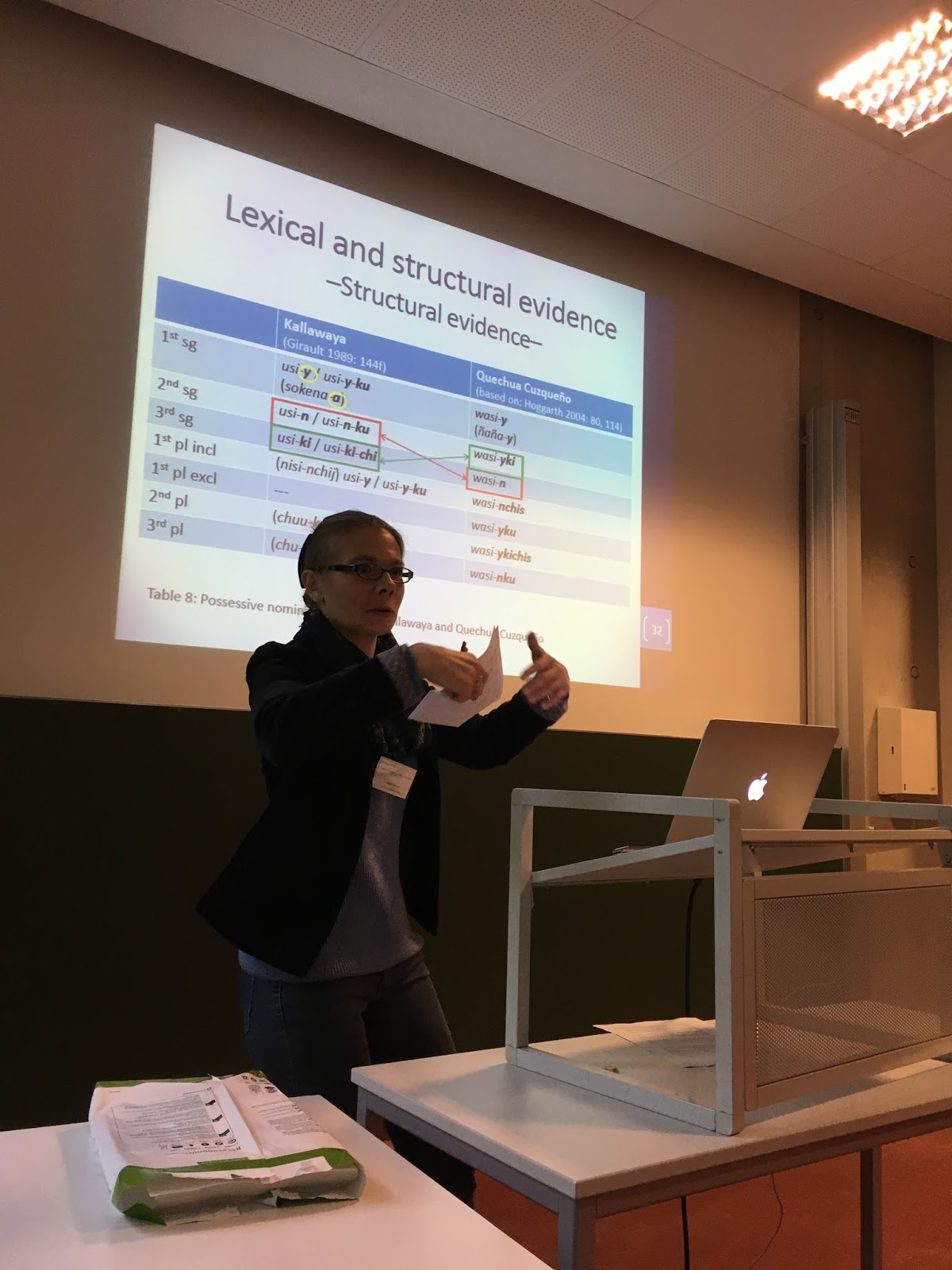
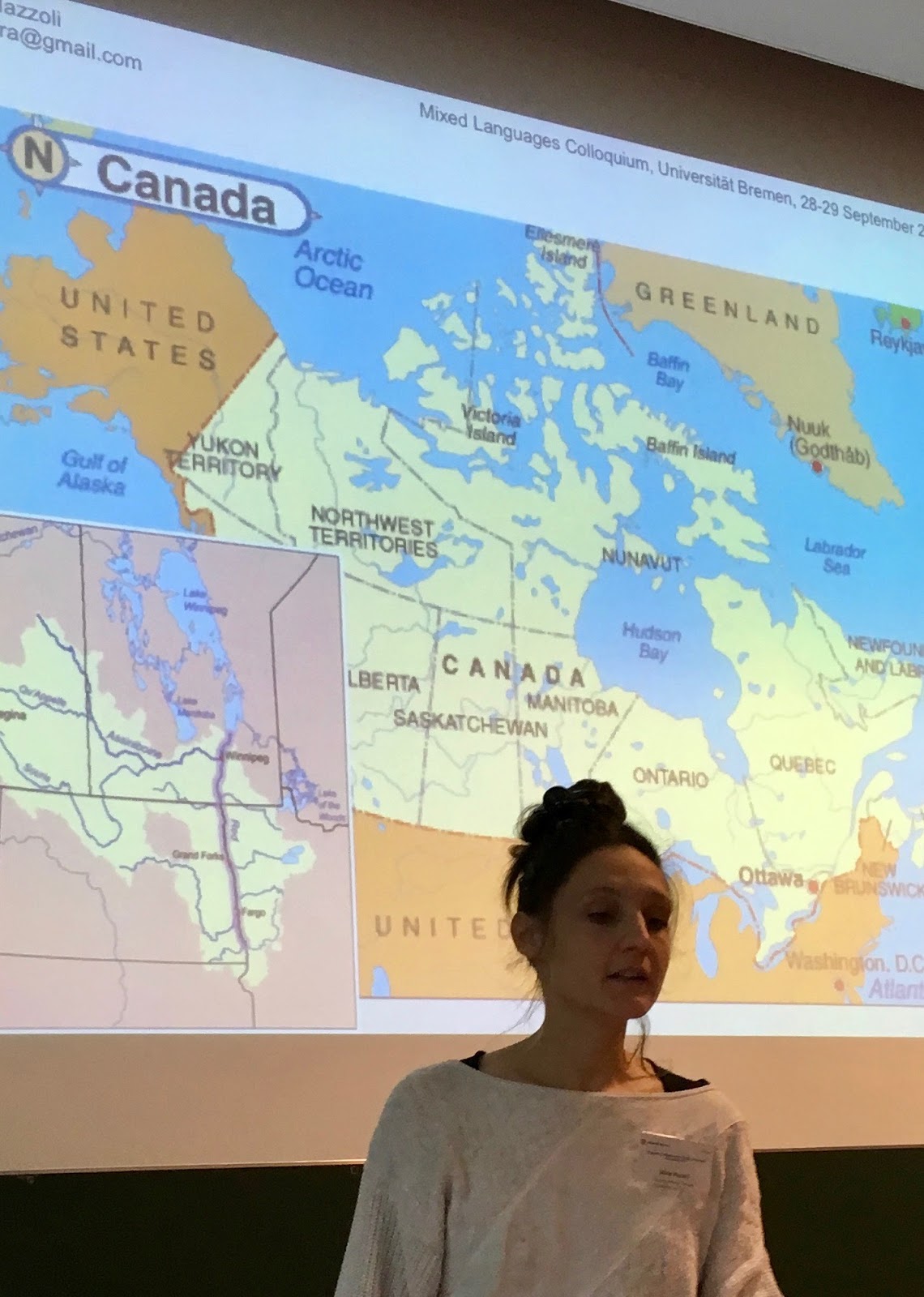
Linguistic Colloquium on Mixed Languages [photos]
On September 28-29, the University of Bremen hosted a colloquium on Mixed
Languages organized by Maria Mazzoli with the support of the
Postcolonial Language Studies team.
Mixed languages have fascinated scholars for decades because they present an intriguing type of language contact. They arise in bilingual settings, often as markers of identity or as secret languages, and they combine parts from different language families or branches, showing unique splits that often challenge theories of genetic classification and contact-induced change.
In the colloquium, we heard presentations by international and German scholars on descriptive and theoretical topics, including languages such as Garifuna, Kallawaya, Media Lengua, Michif, and Ma’a/Mbugu, among others.
We would like to thank all the participants for a great colloquium!
Mixed languages have fascinated scholars for decades because they present an intriguing type of language contact. They arise in bilingual settings, often as markers of identity or as secret languages, and they combine parts from different language families or branches, showing unique splits that often challenge theories of genetic classification and contact-induced change.
In the colloquium, we heard presentations by international and German scholars on descriptive and theoretical topics, including languages such as Garifuna, Kallawaya, Media Lengua, Michif, and Ma’a/Mbugu, among others.
We would like to thank all the participants for a great colloquium!
keynote by Katja Hannß / Norval Smith and Frans Hinskens
Nantke Pecht / keynote by Yaron Matras
Benjamin Saade / Isabel Deibel
dinner at Haus am Walde
keynote by Peter Bakker / Maria Mazzoli
Anthony Grant / Jesse Stewart
keynote by Maarten Mous / group photo of all the participants
Monday, September 18, 2017
Linguistic Colloquium on Mixed Languages, 28-29 September 2017
Dr. Maria Mazzoli and the Postcolonial Language Studies team invite all interested colleagues, students and visitors to the Linguistic Colloquium on Mixed Languages to take place at the University of Bremen on 28th and 29th September 2017.
Invited speakers:
- Peter Bakker (Arhus University)
- Katja Hannß (University of Cologne)
- Yaron Matras (University of Manchester)
- Maarten Mous (Leiden University)
Location: GW1 HS H1010
The program can be downloaded here in .pdf or viewed by clicking on the images below.
Invited speakers:
- Peter Bakker (Arhus University)
- Katja Hannß (University of Cologne)
- Yaron Matras (University of Manchester)
- Maarten Mous (Leiden University)
Location: GW1 HS H1010
The program can be downloaded here in .pdf or viewed by clicking on the images below.
All welcome!
Friday, June 30, 2017
INPUTS lecture series finished
On Thursday, June 29th 2017 we enjoyed the last lecture in the INPUTS Forum series "Changing ecologies: language, culture and the environment". Tendai Mangena, member of our Postcolonial Literary and Cultural Studies team, gave a talk entitled "Traces of Antinomy between Culture and the Law in Gappah's short stories".
The lecture series proved to be a success. We were able to welcome some renowned international guests, including Evelyn Camille from Canada, Epifania Amoo-Adare from Ghana or Sune Vork Steffensen from Denmark. Next to Tendai's, we could also offer a lecture of another colleague in the Postcolonial Literary and Cultural Studies group, Oluseun Tanimomo. And we had the opportunity to establish and strengthen our connections with other German universities by welcoming Kylie Crane (Mainz) and Nico Nassenstein (Cologne).
The series was also successful in terms of content, as the lectures formed a coherent conversation, picking up similar themes but approaching them from different perspectives and using different methods and examples.
Registered users can see the mobile lectures from the series here.
We thank everyone involved in the lecture series: the speakers, the filming team and the audience. Have a nice summer!
Eeva Sippola & Joanna Chojnicka, series organizers
The lecture series proved to be a success. We were able to welcome some renowned international guests, including Evelyn Camille from Canada, Epifania Amoo-Adare from Ghana or Sune Vork Steffensen from Denmark. Next to Tendai's, we could also offer a lecture of another colleague in the Postcolonial Literary and Cultural Studies group, Oluseun Tanimomo. And we had the opportunity to establish and strengthen our connections with other German universities by welcoming Kylie Crane (Mainz) and Nico Nassenstein (Cologne).
The series was also successful in terms of content, as the lectures formed a coherent conversation, picking up similar themes but approaching them from different perspectives and using different methods and examples.
Registered users can see the mobile lectures from the series here.
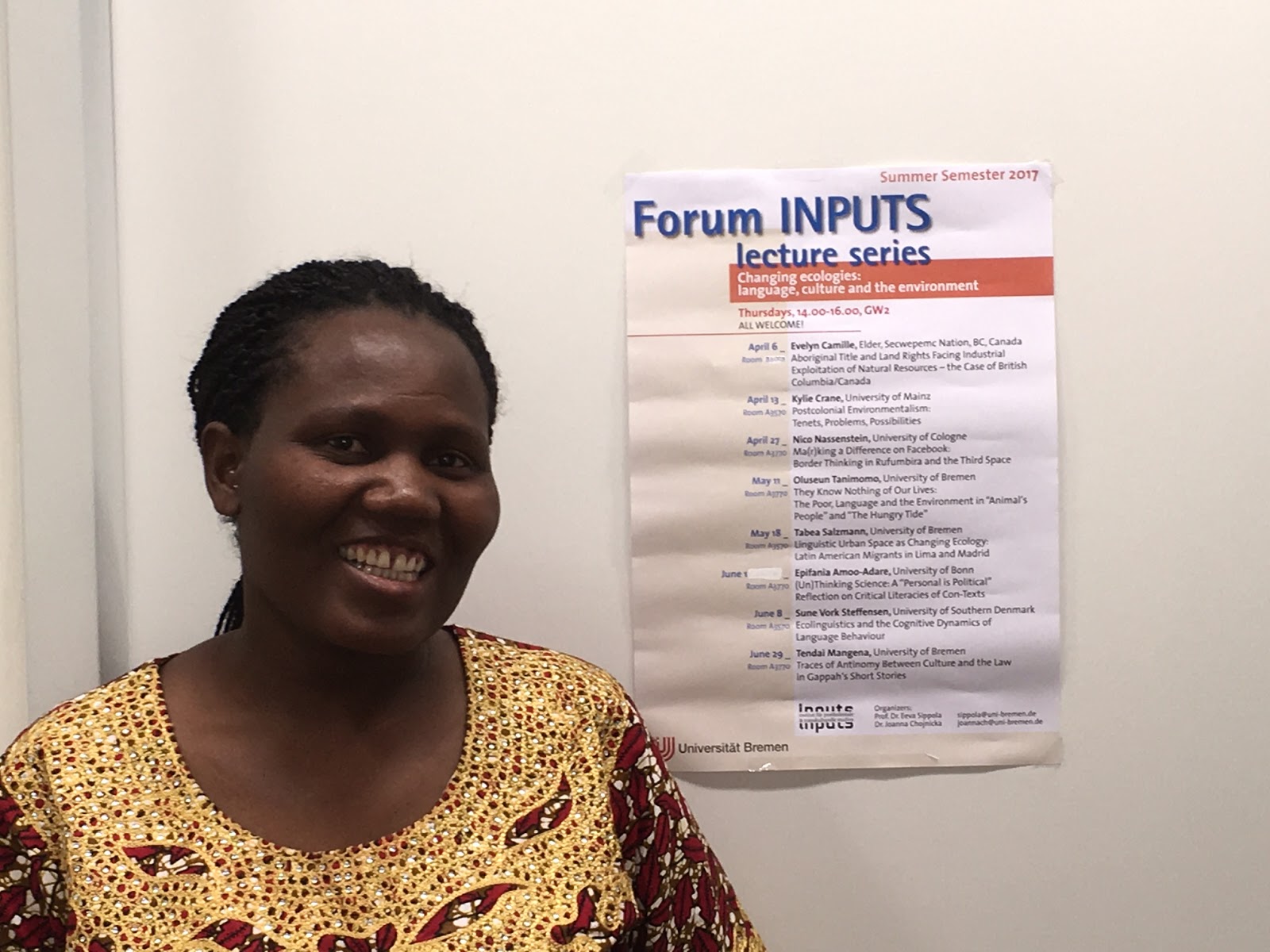
Tendai Mangena in front of the series poster
We thank everyone involved in the lecture series: the speakers, the filming team and the audience. Have a nice summer!
Eeva Sippola & Joanna Chojnicka, series organizers
Monday, April 3, 2017
INPUTS lecture series
"Changing ecologies: language, culture and the environment"
This lecture series will focus on changing ecologies in the global era from linguistic, cultural and environmental perspectives. The ecological approach functions as a transdisciplinary platform for studying the coexistence of languages, communities, and cultures in a society and their interactions with each other and the natural environment. Within this approach, languages and cultures are studied as systems of interrelations; they cannot be studied in isolation from the totality of human behaviour and from natural circumstances, and these circumstances both affect and are shaped by languages and cultures.
The series is organized in cooperation with the Institute for postcolonial and transcultural studies (INPUTS) at the University of Bremen and it serves as the platform for the INPUTS forum. It will feature introductory thematic lectures followed by guest lectures on current research topics.
Attention: Evelyn Camille's talk on April 6 will take place in room B3009.
ALL WELCOME!
Tuesday, March 14, 2017
Learn Tok Pisin!
Tok Pisin Intensive Courses I and II
10-14 and 17-21 July, 2017
Prof. Dr. Craig Alan Volker (Visiting Professor, University of Bremen)
Tok Pisin, also known as New Guinea Pidgin English, is a lingua franca of Papua New Guinea.
Competence in Tok Pisin is indispensable for fieldwork, engagement in development projects, or business in Melanesia. A direct engagement with Tok Pisin is also of interest to linguists interested in the structure of pidgin and creole languages and in the results of intensive language contact.
In these intensive courses, students will attain up to A2 and B1 level proficiency. The lessons will be given in Tok Pisin, English, and/or German.
For more information, see the Uni Bremen Linguistics course list for Summer Semester 2017 at www.fb10.uni-bremen.de/linguistik/, or contact Dr. Marivic Lesho at lesho@uni-bremen.de.
External participants are welcome!
10-14 and 17-21 July, 2017
Prof. Dr. Craig Alan Volker (Visiting Professor, University of Bremen)
Tok Pisin, also known as New Guinea Pidgin English, is a lingua franca of Papua New Guinea.
Competence in Tok Pisin is indispensable for fieldwork, engagement in development projects, or business in Melanesia. A direct engagement with Tok Pisin is also of interest to linguists interested in the structure of pidgin and creole languages and in the results of intensive language contact.
In these intensive courses, students will attain up to A2 and B1 level proficiency. The lessons will be given in Tok Pisin, English, and/or German.
For more information, see the Uni Bremen Linguistics course list for Summer Semester 2017 at www.fb10.uni-bremen.de/linguistik/, or contact Dr. Marivic Lesho at lesho@uni-bremen.de.
External participants are welcome!
Monday, December 19, 2016
Linguistic colloquium on new varieties in the Americas
On December 16th, Postcolonial Language Studies organized a linguistic colloquium with focus on new varieties in the Americas. These are varieties born out of the contact situations of colonial, indigenous, and African languages, such as for example the Afro-Hispanic varieties spoken in Bolivia, Peru, and Ecuador. In the colloquium, we had presentations by local and international scholars about degrees of contact and restructuring in these cases. Many thanks to all the participants!
Programm:
Linguistisches Kolloquium: New Varieties in the Americas
Freitag, 16. Dezember 2016
Gästehaus der Universität Bremen
Auf dem Teerhof 58
Kontakt: Danae Perez Email: danae.perez@es.uzh.ch, Eeva Sippola Email: sippola@uni-bremen.de
Programm:
Linguistisches Kolloquium: New Varieties in the Americas
Freitag, 16. Dezember 2016
Gästehaus der Universität Bremen
Auf dem Teerhof 58
Kontakt: Danae Perez Email: danae.perez@es.uzh.ch, Eeva Sippola Email: sippola@uni-bremen.de
09:00 - 09: 15 Eeva Sippola (Universität Bremen)
Begrüßung und Einführung
09:15 - 10:00 Maria Mazzoli (Universität Bremen)
Michif - a mixed language as a new variety
10:00 - 10:45 Sandro Sessarego (University of Texas at Austin und Universität Freiburg FRIAS)
A new look at the Spanish creole debate: The Legal Hypothesis of Creole Genesis
10:45 - 11:00 Kaffeepause
11:00 - 11:45 Laura Álvarez (Stockholms Universitet)
Cupópia: the Afro-Brazilian speech of Cafundó
11:45 - 12:30 Ana Paulla Braga Mattos (Aarhus Universitet)
The speech variety of Kalunga: an Afro-Brazilian community in Goiás
12:30 - 14:00 Mittagspause
14:00 - 14:45 Albert Wall (Universität Zürich)
What's new about Differential Object Marking in new varieties of Spanish and Portuguese?
14:45 - 15:30 Danae Perez (Universität Bremen und Universität Zürich)
Old and new language varieties in the Central Andes
15:30 - 15:45 Kaffeepause
15:45 - 16:30 Maja Robbers (Universität Bremen)
Contact-induced change in young people's Totonac
16:30 - 17:15 Ana Kondic (MPI SHH Jena)
Spanish influences on Huastec
Sandro Sessarego, Laura Álvarez
Albert Wall, Danae Perez
photo on the right: (from left to right) Eeva Sippola, Albert Wall, Ana Paulla Braga Mattos, Maja Robbers, Sandro Sessarego, Maria Mazzoli, Danae Perez, Laura Álvarez
Thursday, October 20, 2016
Amerika-Semester
Aztekisch, Brasilianisches Portugiesisch, Michif, Papiamentu, Afro-Yungueño, Yukatekisches Maya, Amerikanisches Englisch, und mehr…
Die Sprachen und Kulturen Amerikas, ihre Vergangenheit, Gegenwart und Zukunft, ihre Strukturen und Anwendungsbereiche und ihre Bedeutung für aktuelle wissenschaftliche Diskurse und Forschung. Die Postcolonial Language Studies des Fachbereichs 10 der Universität Bremen bieten gemeinsam mit den Postcolonial Literary and Cultural Studies, der CU Koloniallinguistik, den Studiengängen English-Speaking Cultures und Romanische Sprachwissenschaft sowie nationalen und internationalen Gästen im Wintersemester 2016/2017 einen interdisziplinären Themenschwerpunkt an, der Studierende in Seminaren, Gastvorträgen und einem Workshop zu den Sprachen und Kulturen Amerikas – von Kanada bis Bolivien – die Vielfalt dieses faszinierenden Doppelkontinents näherbringen und dessen zentrale Bedeutung in (post)kolonialen Theorien verdeutlichen soll.
Mehr Informationen: http://www.fb10.uni-bremen.de/schwerpunkt/amerika/default.aspx
Tuesday, May 31, 2016
INPUTS Writer In Residence Dr. Amatoritsero Ede
Together with INPUTS Bremen, Postcolonial Studies hosted its first “Writer-in-Residence” from March through May 2016, the Nigerian-Canadian author and poet Dr. Amatoritsero Ede. The Foundation of the University of Bremen has supported Dr. Ede’s stay, and we thank them very much for this financial support. Dr. Ede was strongly influenced by Wole Soyinka, Nobel Laureate for Literature. Ede’s A Writer’s Pains & Caribbean Blues won the 1998 All-Africa Okigbo Prize for Literature, while Globetrotter & Hitler’s Children was nominated for the 2013 Nigerian Literature Prize. His work has appeared in 11 poetry anthologies, and it was placed second in the first May Ayim Literary Award in 2004 and in the 1993 Association of Nigerian Authors poetry prize. He publishes the Maple Tree Literary Supplement at www.mtls.ca.
During his stay at the University of Bremen, he collaborated with his host, Professor Dr. Kerstin Knopf. At the BCLL#3, he delivered a paper and gave a poetry reading. He also produced new poetry in the wonderful ambience of the Teerhof peninsula in the Weser River, taught a 5-week creative writing course, and delivered a lecture and performed alongside student-writers as part of Faculty 10’s Guest Lecture Series.
You can see the energy-laden performance of Dr. Ede’s poem „Teardrops in the Weser" as well as of the poems and short stories written by students in his creative writing class here.
More information on Ede's stay here.
Friday, April 1, 2016
Ozeanien-Semester
Chamorro, Kiwi-Englisch, Maori, Tagalog, Tok Pisin, Unserdeutsch…
Die Sprachen Ozeaniens und benachbarter Regionen, ihre Strukturen, ihre Kontakte, ihre Geschichte, ihre Erforschung, ihre Bedeutung für unser Verständnis von menschlicher Sprache.
Diesbezüglich wird im Sommersemester 2016 ein spezielles Studienprogramm (BA/MA) mit Modulen, Kolloquien, Workshops, Gastvorträgen und anderen Veranstaltungen angeboten, die sich aus linguistischer Sicht und anderen Blickwinkeln mit der Sprachenwelt Indonesiens, der Philippinen, Papua-Neuguineas, Mikronesiens, Melanesiens und Polynesiens befassen.
Website: Ozeanien-Semester
Tuesday, March 1, 2016
Class On Indigenous Documentary Films And Field Trip To Film Festival
In the class “Studying and Working with Indigenous Films in North America” (WiSe 2015/16) Prof. Kerstin Knopf and Bremen students translated and subtitled the documentary Highway of Tears (dir. Matt Smiley) for screening at the Indianer Inuit: Das Nordamerika Filmfestival in Stuttgart 2016.
We also watched and assessed ten submitted documentary films and selected the award winner in the category “Best Documentary Film.” As a highlight of the class, we travelled to Stuttgart, participated in the film festival and presented the award to the filmmakers of the award winner (SOL, dir. Marie-Hélène Cousineau and Susan Avingaq).
Festival report by Liv Oster (scroll down).
Report in Bremer Uni-Schlüssel by Angelika Rockel with Nani Stelling.
We also watched and assessed ten submitted documentary films and selected the award winner in the category “Best Documentary Film.” As a highlight of the class, we travelled to Stuttgart, participated in the film festival and presented the award to the filmmakers of the award winner (SOL, dir. Marie-Hélène Cousineau and Susan Avingaq).
Festival report by Liv Oster (scroll down).
Report in Bremer Uni-Schlüssel by Angelika Rockel with Nani Stelling.
Subscribe to:
Posts (Atom)