Showing posts with label reports. Show all posts

Monday, November 6, 2017

Postcolonial language studies workshop

On November 2-3 2017, Hanse-Wissenschaftskolleg in Delmenhorst hosted the workshop "Postcolonial Language Studies: Current Perspectives", organized by Prof. Eeva Sippola (postcolonial language studies team) together with Prof. Ingo Warnke (Germanistische Sprachwissenschaft; Interdisziplinäre Linguistik) from the University of Bremen.
The workshop was a closed event during which invited participants from both Germany and abroad presented their projects in postcolonial language studies as well as discussed research gaps, disciplinary challenges and future directions.

Below a few photographs from the event:

 Péter Maiz, Stefan Engelberg, Birte Kellermeier-Rehbein, Bruno Arich-Gerz, Maria Mazzoli

Carsten Levisen, Ingo Warnke, Doris Stolberg

Thursday, October 5, 2017

Linguistic Colloquium on Mixed Languages [photos]

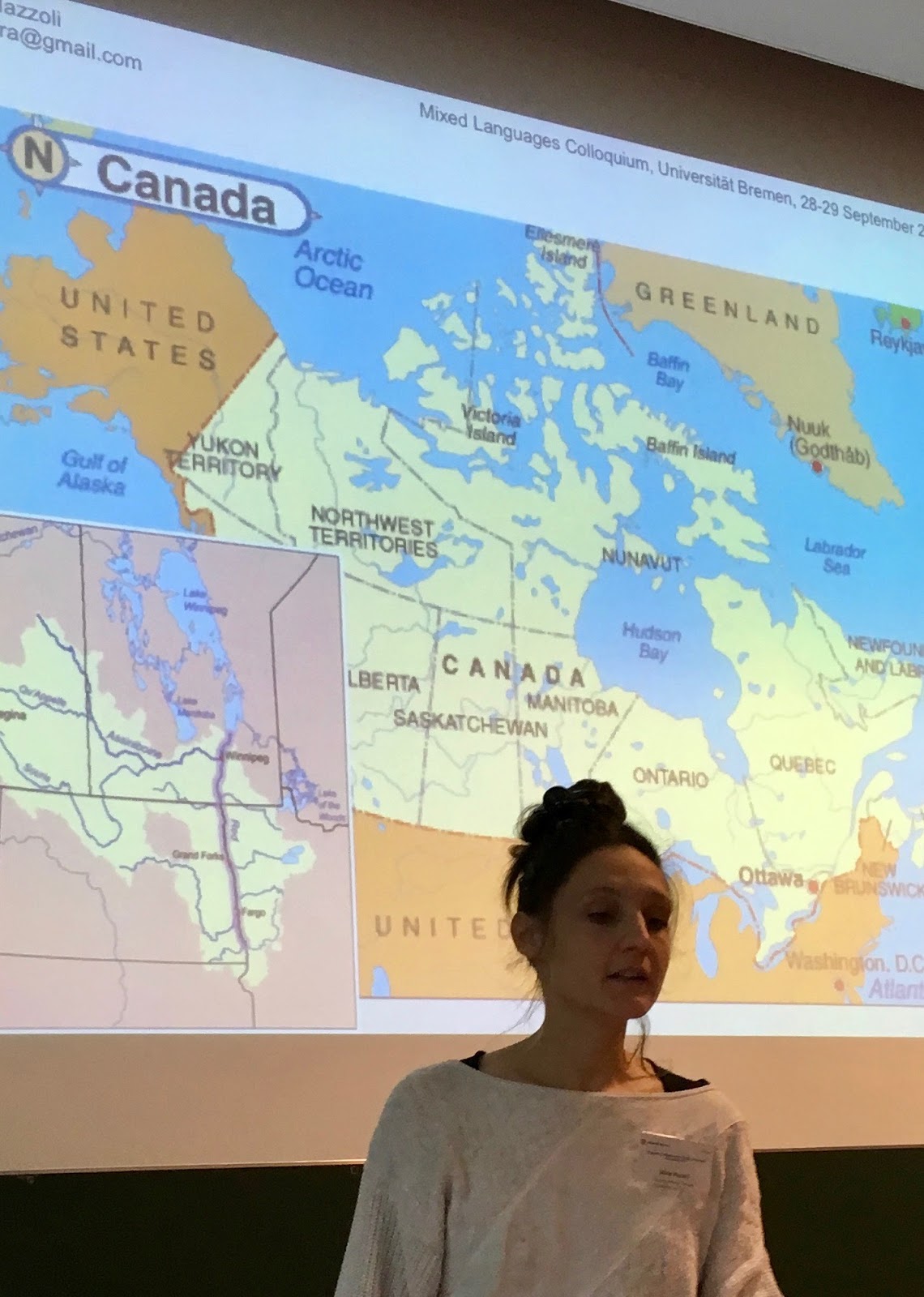
On September 28-29, the University of Bremen hosted a colloquium on Mixed Languages organized by Maria Mazzoli with the support of the Postcolonial Language Studies team.

Mixed languages have fascinated scholars for decades because they present an intriguing type of language contact. They arise in bilingual settings, often as markers of identity or as secret languages, and they combine parts from different language families or branches, showing unique splits that often challenge theories of genetic classification and contact-induced change.

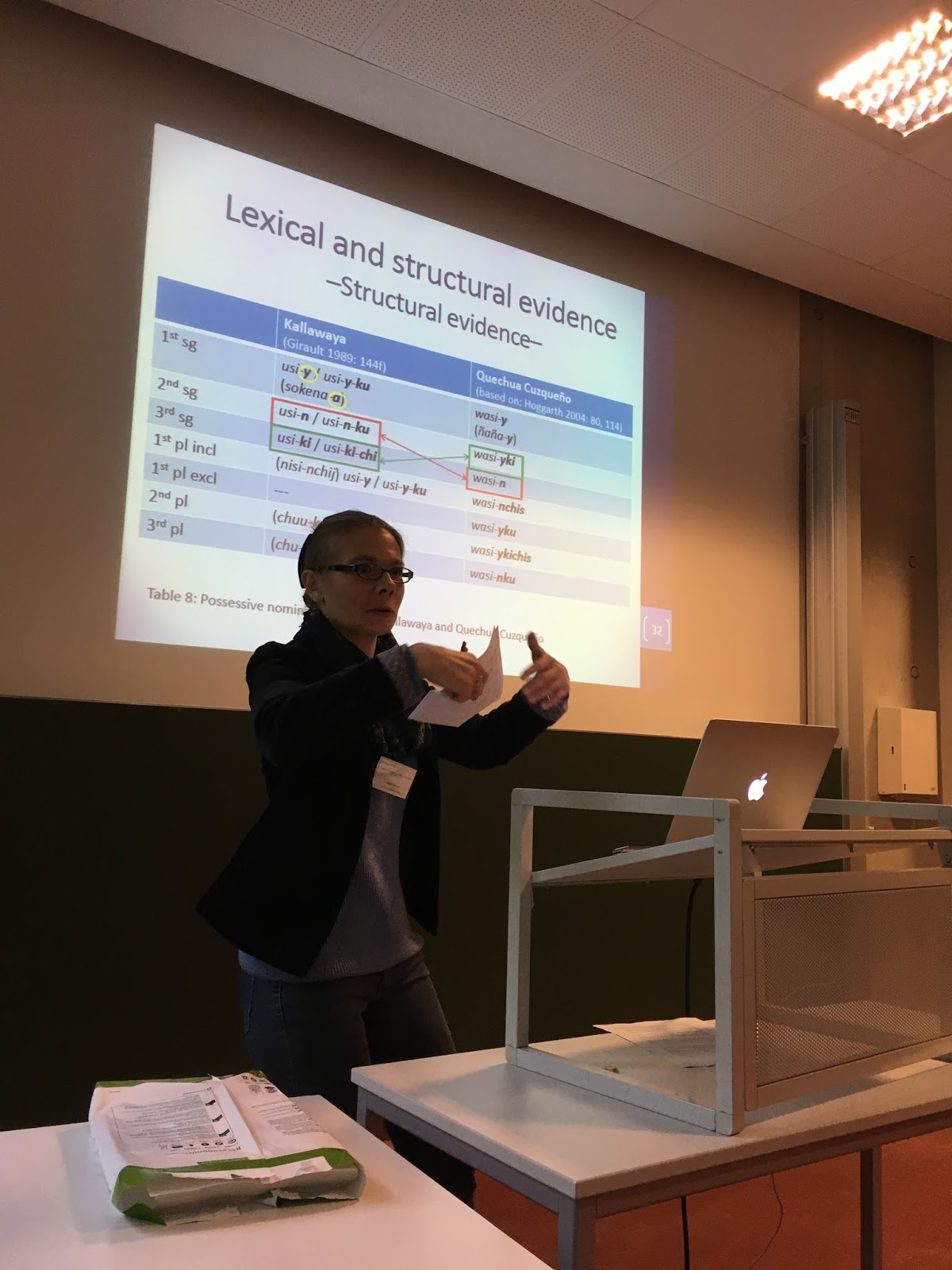
In the colloquium, we heard presentations by international and German scholars on descriptive and theoretical topics, including languages such as Garifuna, Kallawaya, Media Lengua, Michif, and Ma’a/Mbugu, among others.

We would like to thank all the participants for a great colloquium!

 keynote by Katja Hannß / Norval Smith and Frans Hinskens

 Nantke Pecht / keynote by Yaron Matras

 Benjamin Saade / Isabel Deibel

 dinner at Haus am Walde

 keynote by Peter Bakker / Maria Mazzoli

 Anthony Grant / Jesse Stewart

keynote by Maarten Mous / group photo of all the participants

Friday, June 30, 2017

INPUTS lecture series finished

On Thursday, June 29th 2017 we enjoyed the last lecture in the INPUTS Forum series "Changing ecologies: language, culture and the environment". Tendai Mangena, member of our Postcolonial Literary and Cultural Studies team, gave a talk entitled "Traces of Antinomy between Culture and the Law in Gappah's short stories".

The lecture series proved to be a success. We were able to welcome some renowned international guests, including Evelyn Camille from Canada, Epifania Amoo-Adare from Ghana or Sune Vork Steffensen from Denmark. Next to Tendai's, we could also offer a lecture of another colleague in the Postcolonial Literary and Cultural Studies group, Oluseun Tanimomo. And we had the opportunity to establish and strengthen our connections with other German universities by welcoming Kylie Crane (Mainz) and Nico Nassenstein (Cologne).

The series was also successful in terms of content, as the lectures formed a coherent conversation, picking up similar themes but approaching them from different perspectives and using different methods and examples.

Registered users can see the mobile lectures from the series here.

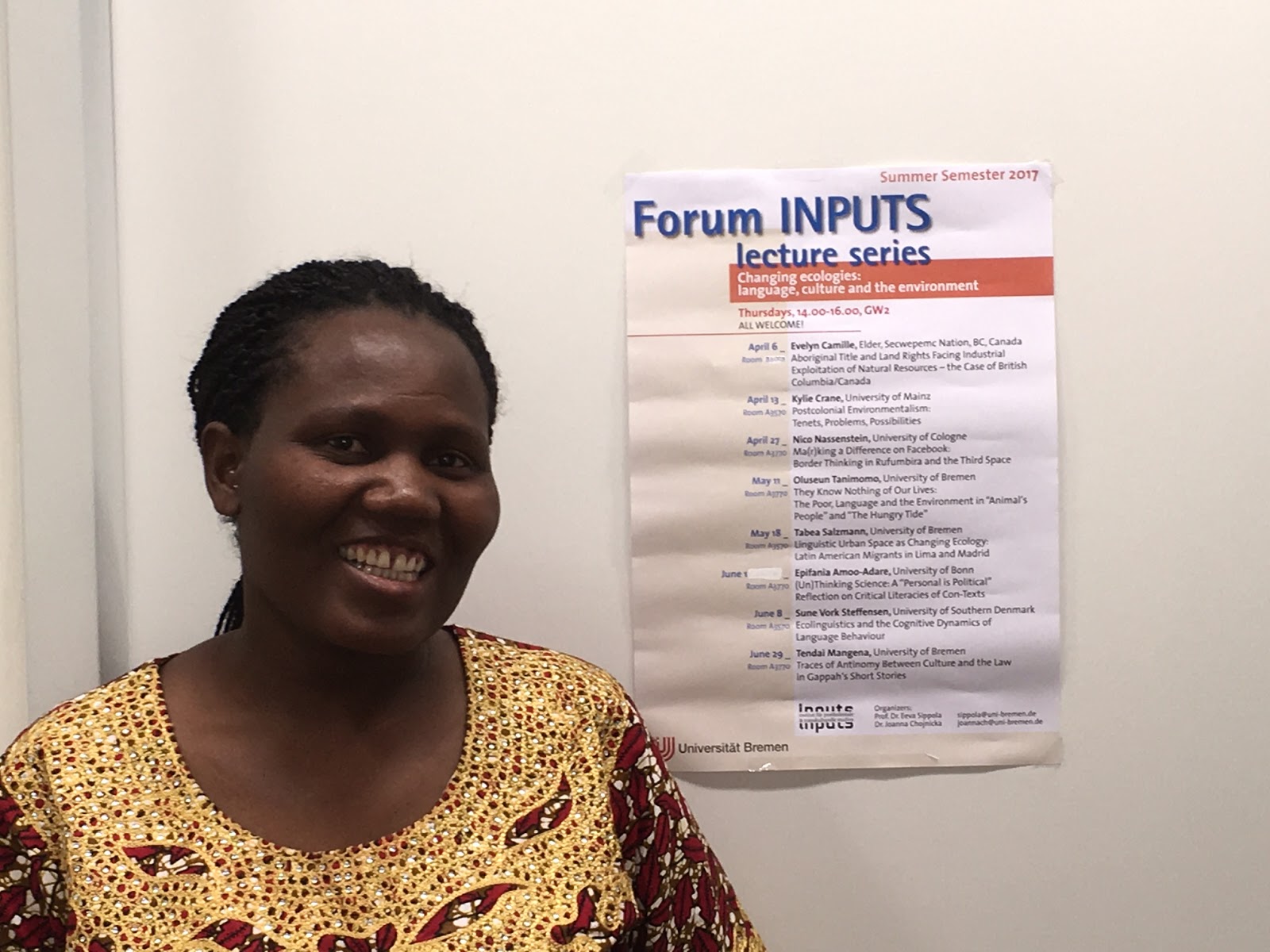
Tendai Mangena in front of the series poster

We thank everyone involved in the lecture series: the speakers, the filming team and the audience. Have a nice summer!
Eeva Sippola & Joanna Chojnicka, series organizers

Monday, June 19, 2017

Open Campus 2017

This year, the Postcolonial Studies group was given the challenging and exciting task of organizing the activities of Faculty 10: Linguistics and Literary Studies at the Open Campus day, which took place on Saturday, June 17th 2017.

Under the supervision of Eeva Sippola and Kerstin Knopf and the coordination of Joanna Chojnicka, a large range of presentations and activities were offered to visitors at the pagoda of Faculty 10. The postcolonial team was supported by the student assistants Michaela Puschmann and Anna Todt as well as the members of Stuga Anglistik.

Throughout the day, fortune-cookies and arabic sweets were handed around and a mini-cinema invited visitors to watch short movies made by the students of MA Transnationale Literaturwissenschaft and a poetry reading. 

Presentations included Postcolonial Literary and Cultural Studies by Prof. Dr. Kerstin Knopf, Postcolonial Language Studies by Dr. Marivic Lesho, Linguistic Fieldwork in Papua New Guinea by Dr. Lidia Mazzitelli and Research-based learning by BA-Student Michaela Puschmann. Many keen visitors could be found in our workshop on the International Phonetic Alphabet, where participants had the chance to read and write in IPA-Symbols. 

INPUTS contributed to our pagoda by presenting their Guayana- and Haiti-Projects, while Michael Claridge offered a photo-exhibition on the students' excursion to Shakespeare's London and on the most recent play by the Parliament of Foules, Doctor Faustus.

At the end of the day, our team enjoyed the concert of Samy Deluxe and celebrated a succesful and rewarding day. Thanks to everyone who contributed - we are already looking forward to the next Open Campus!


Thursday, February 16, 2017

Maria Mazzoli's participation in a workshop in Stockholm

Maria Mazzoli was invited to participate in the workshop Integration, Inclusion, Assimilation and Ghettoisation in a framework of Mobility at the University of Stockholm, on February 9-10.

She presented on her previous work about the linguistic needs of Portuguese migrants in Andorra, and language ideologies in Andorra.

The workshop was organized by Gabriele Iannàccaro and the Department of Romance and Classical Studies, as part of the European project MIME (Mobility and Inclusion in Multilingual Europe).

Workshop poster and program

Workshop participants

Language landscapes - Andorra

Monday, December 19, 2016

Linguistic colloquium on new varieties in the Americas

On December 16th, Postcolonial Language Studies organized a linguistic colloquium with focus on new varieties in the Americas. These are varieties born out of the contact situations of colonial, indigenous, and African languages, such as for example the Afro-Hispanic varieties spoken in Bolivia, Peru, and Ecuador. In the colloquium, we had presentations by local and international scholars about degrees of contact and restructuring in these cases. Many thanks to all the participants!

Programm:
Linguistisches Kolloquium: New Varieties in the Americas
Freitag, 16. Dezember 2016
Gästehaus der Universität Bremen
Auf dem Teerhof 58
Kontakt: Danae Perez Email: danae.perez@es.uzh.ch, Eeva Sippola Email: sippola@uni-bremen.de

09:00 - 09: 15 Eeva Sippola (Universität Bremen)
Begrüßung und Einführung

09:15 - 10:00 Maria Mazzoli (Universität Bremen)
Michif - a mixed language as a new variety

10:00 - 10:45 Sandro Sessarego (University of Texas at Austin und Universität Freiburg FRIAS)
A new look at the Spanish creole debate: The Legal Hypothesis of Creole Genesis

10:45 - 11:00 Kaffeepause

11:00 - 11:45 Laura Álvarez (Stockholms Universitet)
Cupópia: the Afro-Brazilian speech of Cafundó

11:45 - 12:30 Ana Paulla Braga Mattos (Aarhus Universitet)
The speech variety of Kalunga: an Afro-Brazilian community in Goiás

12:30 - 14:00 Mittagspause

14:00 - 14:45 Albert Wall (Universität Zürich)
What's new about Differential Object Marking in new varieties of Spanish and Portuguese?

14:45 - 15:30 Danae Perez (Universität Bremen und Universität Zürich)
Old and new language varieties in the Central Andes

15:30 - 15:45 Kaffeepause

15:45 - 16:30 Maja Robbers (Universität Bremen)
Contact-induced change in young people's Totonac

16:30 - 17:15 Ana Kondic (MPI SHH Jena)
Spanish influences on Huastec

 Sandro Sessarego, Laura Álvarez

 Albert Wall, Danae Perez

photo on the right: (from left to right) Eeva Sippola, Albert Wall, Ana Paulla Braga Mattos, Maja Robbers, Sandro Sessarego, Maria Mazzoli, Danae Perez, Laura Álvarez

Thursday, December 15, 2016

Joanna Chojnicka on ethics in science

On December 15th, Joanna Chojnicka (Postcolonial Language Studies) and Denise Müller-Dum (Institute of Environmental Physics at the University of Bremen) are giving a talk entitled "Ethics and Science - a Transdisciplinary Discussion". The talk takes place within the BYIC (Bremen Young Investigators' Circle) Brown Bag lunch program.

Here's the abstract of the talk:
We would like to invite you to discuss scientific practice and ethical challenges with us. We will introduce the topic with a brief presentation covering the following fundamental and basic questions: What is science? What kinds of values are there in science? What is ethics, and ethics in science in particular? We will also give a short overview of the topics that ethics in science is concerned with beyond good scientific practice.
After that, we will have ample time for discussion. What is your view on ethics in science?  What constitutes good research? What kinds of responsibilities do we bear as researchers?
We are especially interested in discussing researchers’ underlying values that are rarely taken up, that go unnoticed in the business-as-usual of the academic world. In the rush for more challenging, more innovative, more ground-breaking scientific discoveries, do we ever pause to wonder: (Why) do we need to know everything? And are there things that should not be studied? For example, some people think research on climate engineering, deep sea mining or research for military purposes should not be conducted. And similarly: When we speak about animal testing or embryonic stem cell research, this raises the question how we conduct our research and where we draw the line between acceptable and unacceptable means.
You are invited to share your own beliefs and experiences, as well as questions or doubts that you may have encountered in your work. We are looking forward to an exciting, active discussion!
Denise and Joanna

Thursday, October 20, 2016

Fieldwork on Nalik and Tok Pisin

In September 2016, Lidia Federica Mazzitelli (Postcolonial Language Studies) conducted fieldwork on Nalik, an Austronesian Language, and Tok Pisin, an English-based creole, in the village Laraibina, New Ireland Province, Papua New Guinea.

Lidia’s research focuses on the semantics of landscape and orientation systems. She has investigated the lexical and morphosyntactic means used to express landscape semantics in Nalik and Tok Pisin: words that describe landscape entities (‘sea’, ‘mountain’), deictics, directional particles (in Nalik a North-to-West directional system is found), movement verbs. The aim of the project is to understand how the two languages categorize and define landscape objects and how they encode landscape semantics in their grammars. Lidia also began a documentation project on the so far undescribed and undocumented language Lakurumau, spoken in only one village in New Ireland. Lidia’s fieldtrip was part of the cooperation activities of the Oceania theme semester (http://www.fb10.uni-bremen.de/schwerpunkt/ozeanien/default.aspx) supported by the Internationalization Funds of the University of Bremen. In New Ireland, Lidia worked in cooperation with Prof. Dr. Craig Volker (http://www.poco.uni-bremen.de/people.html) who was a visiting lecturer at Postcolonial Language Studies in April/May 2016.

Tuesday, July 12, 2016

Gender, Nation and Diaspora: Post-Conflict Sri Lankan Women’s Writing by Birte Heidemann

On 28 June 2016, Birte Heidemann-Malreddy (Postcolonial Literary and Cultural Studies) gave a talk on "Gender, Nation and Diaspora: Post-Conflict Sri Lankan Women's Writing" at the Sri Lanka Working Group of the South Asia Institute, University of Heidelberg. The poster below offers an abstract of the lecture.


Saturday, July 9, 2016

Institute of Collaborative Language Research - University of Alaska Fairbanks (UAF)

link: http://www.alaska.edu/colang2016

In June 2016 Maria Mazzoli participated in the Institute of Collaborative Language Research (CoLang) at the University of Alaska Fairbanks (UAF), as part of her postdoctoral research project on Michif, the mixed Plains Cree-French language spoken by few Metis communities in Canada and the US. Michif is severely endangered. Today it is spoken by (at most) an estimated 500 Metis speakers. At present, intergenerational transmission of Michif has ceased and no children or people of childbearing age speak the language. All fluent Michif speakers are in their late 60s or older.

In attendance to the CoLang Institute this year were language activists, learners, linguists, speakers, students, teachers, elders, wiki bloggers, archivists, and publishers interested in collaborative research on endangered languages.

CoLang meets every other summer in even-numbered years. The Institute consists of two weeks of workshops followed by a 3 or 4 week long language documentation practicum.

The goals and principles of the Institute are to provide training in documentation, maintenance, revitalization and advocacy for endangered languages, facilitating ethical collaborations between academic and community linguists. CoLang fosters effective practices for in situ language research and resource creation and the maintenance of language diversity, by promoting the creation of lasting resources on under-described languages and assisting community-based language activists in skills development. 

Social media: #colang2016 #languagewarriors #letourgrandparentslanguagelive #rebelsforlanguage

CoLang participants at the University of Alaska Fairbanks, July 1, 2016.    

June 22, 2016, Eliza Jones and Susan Paskvan explain distance delivery of Koyukon language activities in the Yukon-Koyukuk schools.    

Iñupiat danced at Colang’s opening night, June 20, 2016.