Very soon Maria Mazzoli will leave Bremen for her field research in Canada in the context of her postdoctoral Bremen TRAC project. She will spend five months in Winnipeg and join the University of Manitoba - Institute for the Humanities as a research affiliate.
In collaboration with her host Dr. Nicole Rosen, Maria will work with Michif speakers on the structure of complex Michif stems: she will investigate verbal derivation and compositionality in the verb stem, and also productivity of derivational suffixes.
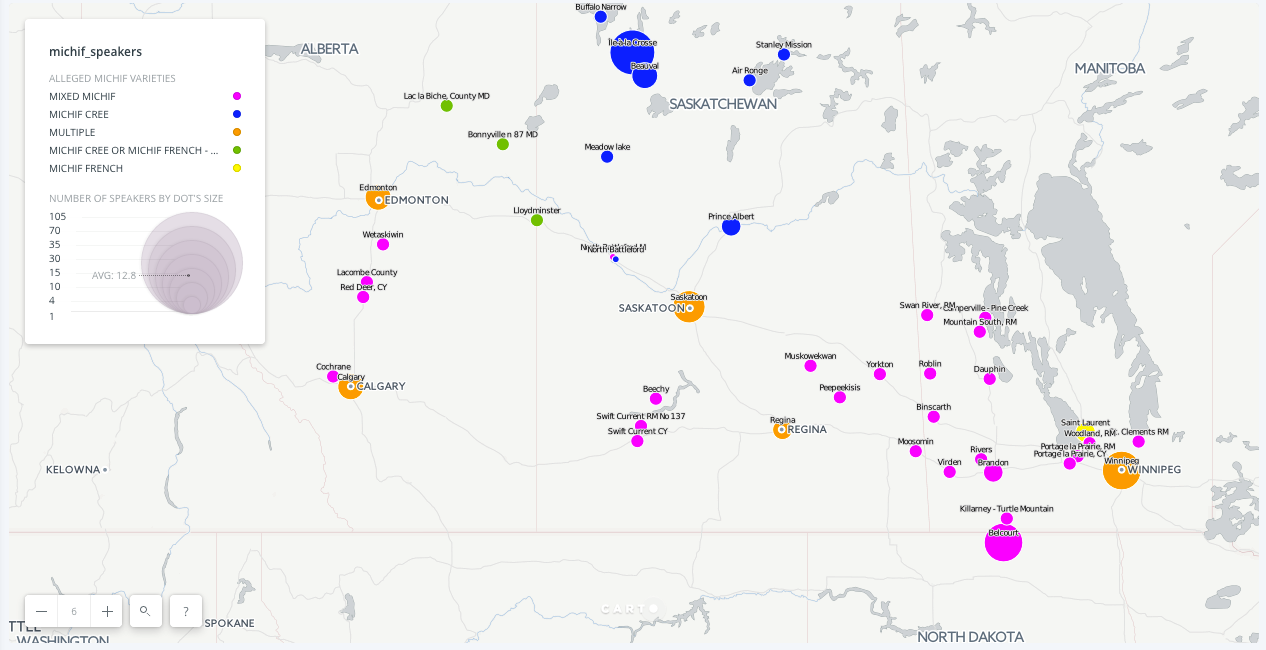
Michif is a Plains Cree - Metis French mixed language. It is spoken today by few people in some traditional Metis communities within the Metis homeland, which is a vast territory spanning from the Rocky Mountains to the Great Lakes, including the three Canadian prairies provinces (Manitoba, Saskatchewan and Alberta) and parts of the Northwest Territories, plus the northern prairies of North Dakota, Montana, and Minnesota in the US.
While an affiliate at the University of Manitoba, Maria aims to combine the work with Metis Elders, fluent Michif speakers, with young Metis interested in deepen their knowledge of the language.
Figure. Distribution of Michif speakers and Michif varieties (source Statistics of Canada 2011).
Showing posts with label fieldwork. Show all posts
Monday, February 20, 2017
Thursday, October 20, 2016
Fieldwork on Nalik and Tok Pisin
In September 2016, Lidia Federica Mazzitelli (Postcolonial Language Studies) conducted fieldwork on Nalik, an Austronesian Language, and Tok Pisin, an English-based creole, in the village Laraibina, New Ireland Province, Papua New Guinea.
Lidia’s research focuses on the semantics of landscape and orientation systems. She has investigated the lexical and morphosyntactic means used to express landscape semantics in Nalik and Tok Pisin: words that describe landscape entities (‘sea’, ‘mountain’), deictics, directional particles (in Nalik a North-to-West directional system is found), movement verbs. The aim of the project is to understand how the two languages categorize and define landscape objects and how they encode landscape semantics in their grammars. Lidia also began a documentation project on the so far undescribed and undocumented language Lakurumau, spoken in only one village in New Ireland. Lidia’s fieldtrip was part of the cooperation activities of the Oceania theme semester (http://www.fb10.uni-bremen.de/schwerpunkt/ozeanien/default.aspx) supported by the Internationalization Funds of the University of Bremen. In New Ireland, Lidia worked in cooperation with Prof. Dr. Craig Volker (http://www.poco.uni-bremen.de/people.html) who was a visiting lecturer at Postcolonial Language Studies in April/May 2016.
Subscribe to:
Posts (Atom)

