Showing posts with label announcements. Show all posts

Friday, November 9, 2018

INPUTS Bremer Denkanstöße

An invitation to an event within the theme semester Global Cotton organized and moderated by Prof. Kerstin Knopf, chair of the Postcolonial Literary and Cultural Studies:

Reihe: INPUTS Bremer Denkanstöße
„Versklavung für Baumwolle: INPUTS liest aus Sven Beckerts King Cotton
13.11.2018, 18 Uhr, Bremer Baumwollbörse, Wachtstraße 17-24, 28195 Bremen
kritische Lesung und Diskussion von Auszügen aus Kapiteln 2, 4 und 5
Moderatorin: Prof. Dr. Kerstin Knopf (U Bremen)
Mitwirkende: Deborah Nyangulu (U Münster), Dr. Sukla Chatterjee (U Bremen), Dr. Detlev Quintern (FSMV U Istanbul), Prof. Dr. Gisela Febel (U Bremen)

Alle sind herzlich eingeladen!

Sunday, November 4, 2018

New member of Postcolonial Literary and Cultural Studies

Dr. Sukla Chatterjee joined the team of Postcolonial Literary and Cultural Studies as a Postdoctoral Researcher on November 1st.

Sukla's areas of interest include Comparative literature, Literary theories, Colonial and postcolonial literature, Body, gender, sexuality, and emotions, Women’s writings, and Colonial relations between Bengal and Britain.

Starting in the next semester, she will also offer classes in the English-Speaking Cultures BA program.

Welcome to Bremen, Sukla! 

Postcolonial Movie Nights: Spotlight on the Arctic


Postcolonial Movie Nights in winter semester 2018/2019
All welcome!

Sunday, September 2, 2018

Postcolonial Oceans conference

The Joint Annual Conference of GAPS and IACPL Postcolonial Oceans. Contradictions and Heterogeneities in the Epistemes of Salt Water, co-organized by the Chair of Postcolonial Literary and Cultural Studies, prof. Kerstin Knopf, is going to take place on 30 May-2 June 2019 at the University of Bremen.

Call for abstracts:
Postcolonial studies have a vested interest in embodied and discursive, social and political, historical and ecological dimensions of oceans. They foreground histories of colonization, imperial wars, the dispossession of territories, enslavement of people, and circulation of goods and ideas, in their entanglements with contemporary postcolonial societies, substantially shaping decolonial knowledge production, postcolonial literatures and academic discourses until today. In his interview on the third space, Homi Bhabha (1990) has pinpointed the inherent contradiction in the genesis of Western modernity: the progressive development of Western societies, individuals and thought traditions according to ideas and values that were monumentalized as the “Enlightenment” on the one hand, and the history of the West as despotic power pursuing various forms of colonial aggression and possession, on the other. Walter Mignolo (2000) and Paul Gilroy (1993) have likewise defined histories of colonization and enslavement as Western modernity’s well-concealed darker side. Studies of oceans and coasts have generated a variety of heterogeneous and sometimes contradictory academic and public discourses from a range of different disciplinary perspectives, including postcolonial studies, the sociology of knowledge, anthropology, literary studies, linguistics and social studies of science and technology. A more systematic perspective on the relations between colonialism, postcolonialism, oceans and lands, rejecting and/or complementing one-sided terrestrial perspectives, emerged only gradually. Rupert Emerson, for instance, defines colonialism as “imposition of white rule on alien peoples inhabiting lands separated by salt water” (1969, 3), understanding salt water – in line with widespread Western ideas of seas and oceans – as separating lands, cultures, people and ideas. In contrast, Gísli Pálsson (1991, xvii) argues that different and isolated worlds were connected by colonial sea voyages into a “global but polarized network of power-relations”. Epeli Hau’ofa (1994; 2008), working from a perspective grown in a marine epistemology, understands diverse Pacific islands, cultures and environments as a network, not separated but linked by the ocean – a “sea of islands”. Extending this idea, Édouard Glissant’s (1997) “archipelagic thinking” shifts understanding the entire world as a connected archipelago, an epistemic shift that is a counterpoint to insular thinking and allows registering the heterogeneities and myriad entanglements and creolization processes in our globalizing world. Early anthropology saw the sea as “atheoretical”, while it became an explicit category of study in environmental history (Gillis 2004, 2011; Bolster 2012; Kehrt/Torma 2014), in geography (Steinberg 2001; Peters 2014, 2015) and maritime anthropology (Astuti 1995; Helmreich 2011). In the construed nature/culture divide, water appears as natural form and “uncontainable flux” as opposed to culture imagined as “land-based idiom”, or it is perceived as materiality to channel (nature) as opposed to being a medium of pleasure, sustenance, travel and disaster (culture) (Helmreich 2011). The nature/culture divide implicates water as one domain “open to control and colonization by the other” (Strathern 1980). Critical maritime history grappled with the opposition between a fully historicized land vs. a supposedly atemporal, “ahistorical” sea that is “outside and beyond history” and researches oceans as polymorphous and transnational contact zones (Klein/Mackenthun, eds. 2004). Indigenous seascape epistemologies are often approaches “to knowing through a visual, spiritual, intellectual, and embodied literacy of the ‘āina (land) and kai (sea)’”, explicitly stressing the nexus between sea and land, and knowing the ocean, wind, and land as interconnected system (Ingersoll 2016). Colonial exploration, colonization and (forced) migration via oceans have created cultural, linguistic and epistemic contact zones where transcultural processes, creole and pidgin languages, and pluriversal knowledges and narratives emerged, however implicated in a hierarchical power matrix (Pratt 1992; Warnke/Stolz/Schmidt-Brücken 2016). The sea prominently features in colonial literatures as both facilitating sea voyages and sustaining colonial myth-making (e.g. Daniel Defoe, Jonathan Swift, Herman Melville, Edgar Allan Poe), whereas in postcolonial literatures it often appears as lethal force enabling colonization and enslavement (e.g. Fred D’Aguiar, George Lamming) or life-giving force and as life itself, integrating all elements and beings (e.g. Eden Robinson, Patricia Grace, Linda Hogan, Alexis Wright). Contradictory and heterogeneous views and ideas of the ocean are commonplace, while knowledge production on and with oceans and saltwater appear to be under-researched through multidisciplinary scholarship. We want to extend the study of oceans and salt water as “theory machine”, an “object that stimulates theoretical formulation” (Galison 2003), and research saltwater knowledge systems, knowledge production and narratives from various epistemological, geographical, cultural and disciplinary perspectives. We are particularly interested in:
  • imaginaries of the seas and oceans in various discourse formations as well as colonial, postcolonial and decolonial genealogies of ocean, coastal and marine spaces;
  • contradictory and heterogeneous concepts of marine spaces; likewise pluriversal ocean and coast-related epistemologies;
  • entangled colonial histories of oceans with regard to the Black, Red and White Atlantic, the Black Pacific, and early non-Western cross-ocean contacts; the circulation of ideas and goods and their role in shaping ocean-related epistemes;
  • salt water spheres as zones of epistemic and cultural contact, neo- and postcolonial communicative practices and linguistic smoothness;
  • linguistic overlaps and language contact, the universalist spread of colonial languages and their status in contact zones, the threat of local languages;
  • the role of European Atlantic port cities (e.g. Bremen, London, Rotterdam, Antwerp) in colonial histories of oceans and the role of port cities outside Europe (e.g. Dakar, Cape Town, Dubai City, Hong Kong) in world trade and global relations, incl. changing discourses constituting such port cities;
  • the ship as vessel enabling and as metaphor for colonization, enslavement, migration, global trade, scientific exploration and various forms of harvesting marine and ocean floor resources;
  • ecological and resource-related aspects of oceans such as rising sea levels, hurricanes, earthquakes, overfishing, resource extraction, and ocean pollution;
  • symbolic oceans in colonial literary and non-literary texts and postcolonial constructions of oceans and salt water epistemologies in literature, theatre, film, electronic and other media.
Please send abstracts outlining your theoretical approach, subject of study and argument (max 400 words) and short bios (max 150 words) to woc@uni-bremen.de by 31 Oct 2018.

Wednesday, April 18, 2018

Friday, January 19, 2018

INVITATION

INVITATION
to a public lecture by
Karen White Butterly
from the Pine Ridge Reservation (South Dakota, USA)

"From Wounded Knee 1973 to Standing Rock 2016"

on Wednesday, 31.01.2018, 14-16 hrs, GW1 B0100

organized by prof. Kerstin Knopf (Postcolonial Literary and Cultural Studies)
Worlds of Contradiction
INPUTS
Übersee Musem Bremen


All welcome!

Monday, November 13, 2017

Invitation to two events in December

The Postcolonial Language Studies team would like to invite all interested colleagues and students to two events organized by Joanna Chojnicka in December 2017. They are both part of the series of events under the common title "Questioning the (in)visible: being critical in humanities and social sciences", for the planning and organization of which Joanna has received the ZF01 Impulse grant.

Thursday, December 7th 2017
18:00-20:00, SH D1020
Open lecture by Jane Sunderland (Lancaster University)
"Questioning the (in)visible: being critical in the humanities and social sciences"

Abstract:
The critical, reflexive, on-going questioning, for example of taken-for-granted assumptions and invisible ideologies, along with exploration of what is not articulated, are arguably epistemological and ethical imperatives in the humanities and social sciences. Nevertheless, the importance of such questioning and exploration is sometimes overlooked. In this lecture I examine some of its relevant components, including the obligation to identify, address and explore contradictions. I focus on the need to look at textual, visual and multimodal absences, omissions, backgrounding and the completely invisible: what could be (more) present but is not, and what, from a certain ideological standpoint, should be. More concretely, I look first at the notion of diversity in foreign language education – what this welcome notion does and does not extend to in practice. Second, I look at the notion of heteronormativity in fiction for young children, the gap this leaves, and to what extent is being satisfactorily addressed.

BIO:
Jane Sunderland is currently an Honorary Reader at Lancaster University, where she was the Director of Studies of the PhD in Applied Linguistics by Thesis and Coursework programme in 2000-2012. Her research interests include gender, language and discourse; Harry Potter and children’s (especially boys‘) literacies; language and gender in African contexts; the representation of gender and sexuality in children’s picturebooks and in language textbooks; gender and sexuality in the language classroom. Jane’s most recent books are the research monographs Language, Gender and Children’s Fiction (2011, Continuum), Gendered Discourses (2004, Palgrave Macmillan), and the advanced coursebook Gender and Language: an Advanced Resourcebook (2006, Routledge). She is currently working on a monograph for Routledge entitled Harry Potter and Young Muggles’ Reading (with Steven Dempster and Joanne Thistlethwaite). She is also co-editor (with Lilian Atanga, Sibonile Ellece and Lia Litosseliti) of Gender and Language in Sub-Saharan Africa: Tradition, Struggle and Change (John Benjamins, 2013), co-editor (with Lia Litosseliti, Kate Harrington and Helen Sauntson) of Gender and Language Research Methodologies (Palgrave, 2008) and (with Lia Litosseliti) of Gender Identity and Discourse Analysis (John Benjamins, 2002). Jane has published articles in Visual Communication, Language and Literature, Journal of Pragmatics, Gender and Education, ELT Journal, System, Language Teaching Research, Discourse and Society, Language Teaching, Language and Education, Linguistics and Education and Gender and Language.

The organization of the lecture is supported by the Worlds of Contradiction (WoC).

Friday, December 8th 2017
09:00-14:00, GW1 B1070
A seminar for PhD students and advanced MA students from social sciences and humanities
"Become reflexive and move academia forward"
Trainers: Joanna Chojnicka (Bremen), Lukasz Pakula (Poznań, Poland), Anna Agaltsova (Moscow, Russia)

Rolling in your academic career? Writing articles, enhancing your citation index, applying for and participating in conferences? Just wait for a second. Do you ask yourself why you are doing it and doing it this way?

Once you got fascinated by something (say gender inbalance) and decided to study it further at university. It was not always easy, but you've been learning new theories and methods, going on field trips, polishinhg your research questions and some 10 years later, here you are researching some really complicated problems (say gender and climate change in eco-cultural studies). But why? And why this way? Why is it important to know the answers to these questions?

We are all biased as researchers: by the life experience, by the context this experience is used in, by the educational curriculum, by the publishing tradition. We choose some methods in favour of others not necessarily because they are better for our research questions. The latter is also quite far from a free choice. The process of collecting data is biased by the context (situational, social, historical, you name it) and interpreting it is biased as well. You think you are on the safe side by choosing quantitative data and statistics? Guess what, no. Not at all. The best part of it you need to be reflexive and think critically to address soical problems and not stick in the Ivory tower of academia.

During this 4-hour workshop you will learn the frameworks of critical thinking and apply it to your own research. You will train on real reserach cases and receive the input from the interdisciplinary group.

You want to join to:
  • Explore the benefits of researcher's reflexivity 
  • Brainstorm your own research within an interdisciplinary group
  • Train reflexivity on real research cases 
  • Establish theoretical and methodological frameworks of critical thinking
  • Move academia forward! 

The organization of the seminar is supported by the Bremen Early Career Resercher Development (BYRD).

Monday, November 6, 2017

Postcolonial movie nights


Program of the Postcolonial movie nights in Winter semester 2017/2018
All welcome!

Monday, September 18, 2017

Linguistic Colloquium on Mixed Languages, 28-29 September 2017

Dr. Maria Mazzoli and the Postcolonial Language Studies team invite all interested colleagues, students and visitors to the Linguistic Colloquium on Mixed Languages to take place at the University of Bremen on 28th and 29th September 2017.

Invited speakers:
- Peter Bakker (Arhus University)
- Katja Hannß (University of Cologne)
- Yaron Matras (University of Manchester)
- Maarten Mous (Leiden University)

Location: GW1 HS H1010

The program can be downloaded here in .pdf or viewed by clicking on the images below.


All welcome!

Monday, April 3, 2017

INPUTS lecture series

"Changing ecologies: language, culture and the environment"


This lecture series will focus on changing ecologies in the global era from linguistic, cultural and environmental perspectives. The ecological approach functions as a transdisciplinary platform for studying the coexistence of languages, communities, and cultures in a society and their interactions with each other and the natural environment. Within this approach, languages and cultures are studied as systems of interrelations; they cannot be studied in isolation from the totality of human behaviour and from natural circumstances, and these circumstances both affect and are shaped by languages and cultures.

The series is organized in cooperation with the Institute for postcolonial and transcultural studies (INPUTS) at the University of Bremen and it serves as the platform for the INPUTS forum. It will feature introductory thematic lectures followed by guest lectures on current research topics. 


Attention: Evelyn Camille's talk on April 6 will take place in room B3009.


ALL WELCOME!

Tuesday, March 28, 2017

Invitation to a talk by Evelyn Camille

Evelyn Camille (Elder, Secwepemc Nation, BC, Canada)


"Aboriginal Title and Land-Rights facing Industrial Exploitation of Natural Resources The Case of British Columbia/Canada


Thursday, 6 April 2017, 14:00-16:00
GW2 B3009

Lecture within the INPUTS lecture series "Changing ecologies: language, culture and the environment" organised by Eeva Sippola and Joanna Chojnicka

Abstract:
Traditional land rights have been questioned by the European colonizers as soon as the later started claiming the land for themselves. Successively treaties have been signed between the First Nations and the Newcomers. The Royal Proclamation of 1763 declared the Indigenous Nations as sovereign partners within this process. Yet, oral traditions of these treaties transmit a different understanding of these treaties than their written versions. Within the manifold local treaty-situations British Columbia holds a particular position, because many First Nations in this area never surrendered their traditional homelands nor signed general treaties with the Canadian government. They immediately started political and legal actions in order to defend their traditional rights. The Secwepemc Nation, represented here by Elder Evelyn Camille, is one of these Nations.

This presentation will deal with traditional Secwepemc land use, rights and title, and their current struggle to protect their natural resources against destruction by mindless industrial exploitation.


ALL WELCOME!

Tuesday, March 14, 2017

Learn Tok Pisin!

Tok Pisin Intensive Courses I and II 
10-14 and 17-21 July, 2017
Prof. Dr. Craig Alan Volker (Visiting Professor, University of Bremen)

Tok Pisin, also known as New Guinea Pidgin English, is a lingua franca of Papua New Guinea.

Competence in Tok Pisin is indispensable for fieldwork, engagement in development projects, or business in Melanesia. A direct engagement with Tok Pisin is also of interest to linguists interested in the structure of pidgin and creole languages and in the results of intensive language contact.

In these intensive courses, students will attain up to A2 and B1 level proficiency. The lessons will be given in Tok Pisin, English, and/or German.

 For more information, see the Uni Bremen Linguistics course list for Summer Semester 2017 at www.fb10.uni-bremen.de/linguistik/, or contact Dr. Marivic Lesho at lesho@uni-bremen.de.

External participants are welcome!

Tuesday, March 7, 2017

Linguistic Colloquium on Mixed Languages: Call for Papers

Linguistic Colloquium on Mixed Languages
University of Bremen
September 28-29, 2017
Call for Papers

Mixed languages have fascinated scholars for decades (e.g. Bakker & Mous 1994, Auer 1999, Matras & Bakker 2003, Meakins 2013) because they present an intriguing type of language contact. They arise in bilingual settings, often as markers of identity or as secret languages, and they combine parts from different language families or branches, showing unique splits that often challenge theories of genetic classification and contact-induced change.

The aim of this colloquium is to examine the current state of the theoretical and empirical debate on mixed languages. We welcome contributions that deal with any aspect of mixed language varieties, for example:
- descriptive and documentation approaches to mixed languages
- theoretical discussions on mixed languages, their origin, and development
- mixed languages in comparison to creoles and pidgins
- different types of language mixing practices

Invited speakers:
Peter Bakker (Aarhus University)
Katja Hannß (University of Cologne)
Yaron Matras (University of Manchester)
Marten Mous (Leiden University)

Please submit your abstracts by May 5, 2017 by email to mazzoli@uni-bremen.de. Please provide the title of the paper, name(s) of the author(s), academic title, and affiliation in the abstract. The abstracts should not exceed 500 words. Notification of acceptance can be expected by June 5, 2017. Papers will be given in English, and they should not exceed 30 minutes plus 10 minutes discussion time.

The meeting is organized by the Postcolonial Language Studies research group as part of the Linguistic Colloquium series at the Institute for General and Applied Linguistics (IAAS), University of Bremen.

Important dates:
Submission deadline: May 5, 2017
Announcement of acceptance: June 5, 2017
Conference: September 28-29, 2017

Contact:
Maria Mazzoli mazzoli@uni-bremen.de
Eeva Sippola sippola@uni-bremen.de

Monday, February 20, 2017

Maria Mazzoli's fieldwork in Canada

Very soon Maria Mazzoli will leave Bremen for her field research in Canada in the context of her postdoctoral Bremen TRAC project. She will spend five months in Winnipeg and join the University of Manitoba - Institute for the Humanities as a research affiliate.

In collaboration with her host Dr. Nicole Rosen, Maria will work with Michif speakers on the structure of complex Michif stems: she will investigate verbal derivation and compositionality in the verb stem, and also productivity of derivational suffixes.

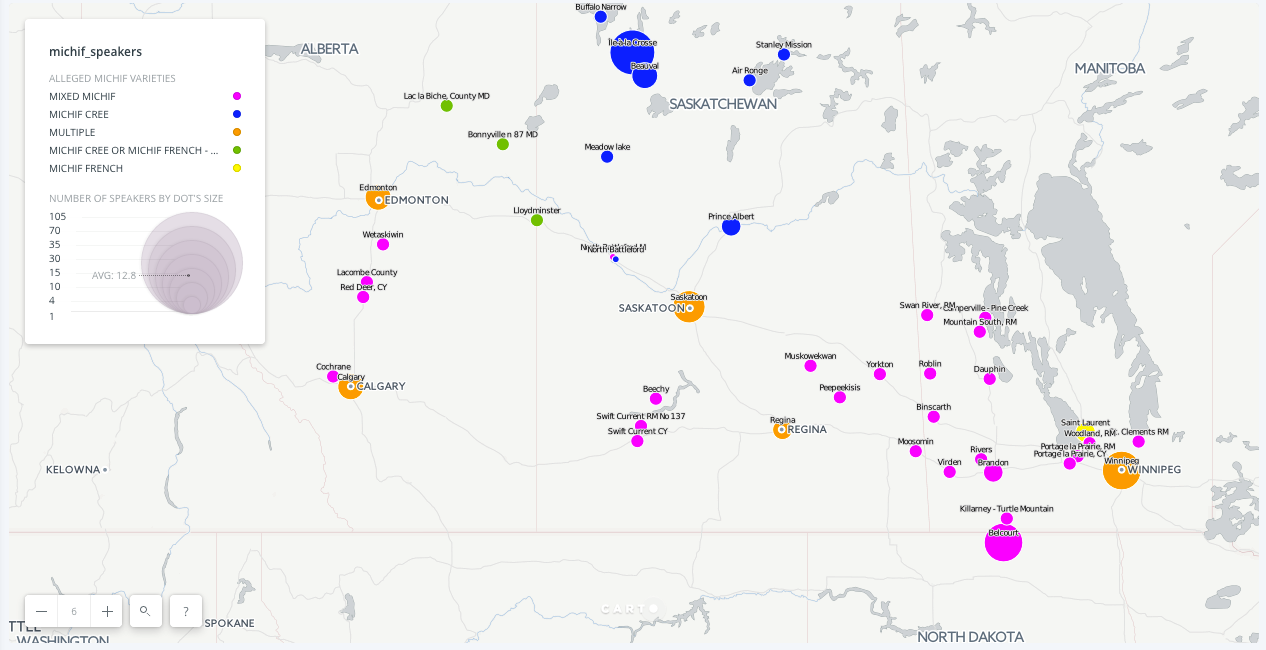
Michif is a Plains Cree - Metis French mixed language. It is spoken today by few people in some traditional Metis communities within the Metis homeland, which is a vast territory spanning from the Rocky Mountains to the Great Lakes, including the three Canadian prairies provinces (Manitoba, Saskatchewan and Alberta) and parts of the Northwest Territories, plus the northern prairies of North Dakota, Montana, and Minnesota in the US.

While an affiliate at the University of Manitoba, Maria aims to combine the work with Metis Elders, fluent Michif speakers, with young Metis interested in deepen their knowledge of the language.

Figure. Distribution of Michif speakers and Michif varieties (source Statistics of Canada 2011).

Thursday, January 12, 2017

Guest lecture: Dr. Nicole Perry, "Adventure on the South Seas: Christian Kracht's 'Imperium' and the Real August Engelhardt"

 English version below

Zeit und Ort: 17.01.2017 um 16:15 Uhr im GW2, Raum B3010
Titel des Gastvortrags: "Adventure on the South Seas: Christian Kracht's 'Imperium' and the Real August Engelhardt"
Christian Kracht’s 2012 blockbuster Imperium highlights Germany’s imperial legacy in the South Pacific and has awakened a new interest in the former German colonies of the South Pacific. His protagonist, the delicate but driven August Engelhardt, a character one could only believe to be a creation of fiction, is based on the founder of the ‘Coconut Cult’.
Kracht writes of a Germany driven by excess and greed, which he juxtaposes with Engelhardt and his desire for an alternative lifestyle. This presentation examines Kracht’s imperial critique and introduces the real August Engelhardt, writer of A Carefree Future (1898), advocate of a coconut diet and sun worship, whose lifestyle and person was in stark contrast to that of the Wilhelminian German of the late 19th Century.
Vortragende: Dr. Nicole Perry, University of Auckland, New Zealand
Nicole Perry is a Lecturer in German at the University of Auckland, New Zealand. She is also co-director of the Research Centre for Germanic Connections in New Zealand and the South Pacific. After completing her PhD at the University of Toronto in Germanic Languages and Literatures, Nicole was a Postdoctoral Fellow at the University of Vienna. She is currently a Lise Meitner Programme fellowship holder based at the University of Vienna for her project  ‘Performing Germanness, Reclaiming Aboriginality’, which discusses North American Indigenous reexaminations of the German ‘Indianer’ image. 
_______________________________________________________________

Where and when: January, 17th 2017 at 04:15 p.m. in GW2, B3010
Title of the Guest lecture: "Adventure on the South Seas: Christian Kracht's 'Imperium' and the Real August Engelhardt"
Christian Kracht’s 2012 blockbuster Imperium highlights Germany’s imperial legacy in the South Pacific and has awakened a new interest in the former German colonies of the South Pacific. His protagonist, the delicate but driven August Engelhardt, a character one could only believe to be a creation of fiction, is based on the founder of the ‘Coconut Cult’.
Kracht writes of a Germany driven by excess and greed, which he juxtaposes with Engelhardt and his desire for an alternative lifestyle. This presentation examines Kracht’s imperial critique and introduces the real August Engelhardt, writer of A Carefree Future (1898), advocate of a coconut diet and sun worship, whose lifestyle and person was in stark contrast to that of the Wilhelminian German of the late 19th Century.
Biographical brief Dr Nicole Perry, University of Auckland, New Zealand
Nicole Perry is a Lecturer in German at the University of Auckland, New Zealand. She is also co-director of the Research Centre for Germanic Connections in New Zealand and the South Pacific. After completing her PhD at the University of Toronto in Germanic Languages and Literatures, Nicole was a Postdoctoral Fellow at the University of Vienna. She is currently a Lise Meitner Programme fellowship holder based at the University of Vienna for her project  ‘Performing Germanness, Reclaiming Aboriginality’, which discusses North American Indigenous reexaminations of the German ‘Indianer’ image. 

Monday, October 24, 2016

New colleague in Postcolonial Language Studies

Danae M. Perez joined the Postcolonial Language Studies team in September 2016 funded by a Swiss National Science Foundation PostDoc Mobility grant. She received her PhD in Linguistics and Anthropology at the University of Zurich in 2015 on language shift in a former English-speaking colony in Paraguay and is currently carrying out research into Afro-Iberian speech varieties. Her research interests are contact linguistics, creole studies, and linguistic anthropology.

More information on Danae's work can be found here (University of Zurich website).

Welcome to Bremen, Danae!

Thursday, October 20, 2016

Amerika-Semester


Aztekisch, Brasilianisches Portugiesisch, Michif, Papiamentu, Afro-Yungueño, Yukatekisches Maya, Amerikanisches Englisch, und mehr… 

Die Sprachen und Kulturen Amerikas, ihre Vergangenheit, Gegenwart und Zukunft, ihre Strukturen und Anwendungsbereiche und ihre Bedeutung für aktuelle wissenschaftliche Diskurse und Forschung. Die Postcolonial Language Studies des Fachbereichs 10 der Universität Bremen bieten gemeinsam mit den Postcolonial Literary and Cultural Studies, der CU Koloniallinguistik, den Studiengängen English-Speaking Cultures und Romanische Sprachwissenschaft sowie nationalen und internationalen Gästen im Wintersemester 2016/2017 einen interdisziplinären Themenschwerpunkt an, der Studierende in Seminaren, Gastvorträgen und einem Workshop zu den Sprachen und Kulturen Amerikas – von Kanada bis Bolivien – die Vielfalt dieses faszinierenden Doppelkontinents näherbringen und dessen zentrale Bedeutung in (post)kolonialen Theorien verdeutlichen soll.

Mehr Informationen: http://www.fb10.uni-bremen.de/schwerpunkt/amerika/default.aspx