Showing posts with label conferences. Show all posts

Sunday, September 2, 2018

Postcolonial Oceans conference

The Joint Annual Conference of GAPS and IACPL Postcolonial Oceans. Contradictions and Heterogeneities in the Epistemes of Salt Water, co-organized by the Chair of Postcolonial Literary and Cultural Studies, prof. Kerstin Knopf, is going to take place on 30 May-2 June 2019 at the University of Bremen.

Call for abstracts:
Postcolonial studies have a vested interest in embodied and discursive, social and political, historical and ecological dimensions of oceans. They foreground histories of colonization, imperial wars, the dispossession of territories, enslavement of people, and circulation of goods and ideas, in their entanglements with contemporary postcolonial societies, substantially shaping decolonial knowledge production, postcolonial literatures and academic discourses until today. In his interview on the third space, Homi Bhabha (1990) has pinpointed the inherent contradiction in the genesis of Western modernity: the progressive development of Western societies, individuals and thought traditions according to ideas and values that were monumentalized as the “Enlightenment” on the one hand, and the history of the West as despotic power pursuing various forms of colonial aggression and possession, on the other. Walter Mignolo (2000) and Paul Gilroy (1993) have likewise defined histories of colonization and enslavement as Western modernity’s well-concealed darker side. Studies of oceans and coasts have generated a variety of heterogeneous and sometimes contradictory academic and public discourses from a range of different disciplinary perspectives, including postcolonial studies, the sociology of knowledge, anthropology, literary studies, linguistics and social studies of science and technology. A more systematic perspective on the relations between colonialism, postcolonialism, oceans and lands, rejecting and/or complementing one-sided terrestrial perspectives, emerged only gradually. Rupert Emerson, for instance, defines colonialism as “imposition of white rule on alien peoples inhabiting lands separated by salt water” (1969, 3), understanding salt water – in line with widespread Western ideas of seas and oceans – as separating lands, cultures, people and ideas. In contrast, Gísli Pálsson (1991, xvii) argues that different and isolated worlds were connected by colonial sea voyages into a “global but polarized network of power-relations”. Epeli Hau’ofa (1994; 2008), working from a perspective grown in a marine epistemology, understands diverse Pacific islands, cultures and environments as a network, not separated but linked by the ocean – a “sea of islands”. Extending this idea, Édouard Glissant’s (1997) “archipelagic thinking” shifts understanding the entire world as a connected archipelago, an epistemic shift that is a counterpoint to insular thinking and allows registering the heterogeneities and myriad entanglements and creolization processes in our globalizing world. Early anthropology saw the sea as “atheoretical”, while it became an explicit category of study in environmental history (Gillis 2004, 2011; Bolster 2012; Kehrt/Torma 2014), in geography (Steinberg 2001; Peters 2014, 2015) and maritime anthropology (Astuti 1995; Helmreich 2011). In the construed nature/culture divide, water appears as natural form and “uncontainable flux” as opposed to culture imagined as “land-based idiom”, or it is perceived as materiality to channel (nature) as opposed to being a medium of pleasure, sustenance, travel and disaster (culture) (Helmreich 2011). The nature/culture divide implicates water as one domain “open to control and colonization by the other” (Strathern 1980). Critical maritime history grappled with the opposition between a fully historicized land vs. a supposedly atemporal, “ahistorical” sea that is “outside and beyond history” and researches oceans as polymorphous and transnational contact zones (Klein/Mackenthun, eds. 2004). Indigenous seascape epistemologies are often approaches “to knowing through a visual, spiritual, intellectual, and embodied literacy of the ‘āina (land) and kai (sea)’”, explicitly stressing the nexus between sea and land, and knowing the ocean, wind, and land as interconnected system (Ingersoll 2016). Colonial exploration, colonization and (forced) migration via oceans have created cultural, linguistic and epistemic contact zones where transcultural processes, creole and pidgin languages, and pluriversal knowledges and narratives emerged, however implicated in a hierarchical power matrix (Pratt 1992; Warnke/Stolz/Schmidt-Brücken 2016). The sea prominently features in colonial literatures as both facilitating sea voyages and sustaining colonial myth-making (e.g. Daniel Defoe, Jonathan Swift, Herman Melville, Edgar Allan Poe), whereas in postcolonial literatures it often appears as lethal force enabling colonization and enslavement (e.g. Fred D’Aguiar, George Lamming) or life-giving force and as life itself, integrating all elements and beings (e.g. Eden Robinson, Patricia Grace, Linda Hogan, Alexis Wright). Contradictory and heterogeneous views and ideas of the ocean are commonplace, while knowledge production on and with oceans and saltwater appear to be under-researched through multidisciplinary scholarship. We want to extend the study of oceans and salt water as “theory machine”, an “object that stimulates theoretical formulation” (Galison 2003), and research saltwater knowledge systems, knowledge production and narratives from various epistemological, geographical, cultural and disciplinary perspectives. We are particularly interested in:
  • imaginaries of the seas and oceans in various discourse formations as well as colonial, postcolonial and decolonial genealogies of ocean, coastal and marine spaces;
  • contradictory and heterogeneous concepts of marine spaces; likewise pluriversal ocean and coast-related epistemologies;
  • entangled colonial histories of oceans with regard to the Black, Red and White Atlantic, the Black Pacific, and early non-Western cross-ocean contacts; the circulation of ideas and goods and their role in shaping ocean-related epistemes;
  • salt water spheres as zones of epistemic and cultural contact, neo- and postcolonial communicative practices and linguistic smoothness;
  • linguistic overlaps and language contact, the universalist spread of colonial languages and their status in contact zones, the threat of local languages;
  • the role of European Atlantic port cities (e.g. Bremen, London, Rotterdam, Antwerp) in colonial histories of oceans and the role of port cities outside Europe (e.g. Dakar, Cape Town, Dubai City, Hong Kong) in world trade and global relations, incl. changing discourses constituting such port cities;
  • the ship as vessel enabling and as metaphor for colonization, enslavement, migration, global trade, scientific exploration and various forms of harvesting marine and ocean floor resources;
  • ecological and resource-related aspects of oceans such as rising sea levels, hurricanes, earthquakes, overfishing, resource extraction, and ocean pollution;
  • symbolic oceans in colonial literary and non-literary texts and postcolonial constructions of oceans and salt water epistemologies in literature, theatre, film, electronic and other media.
Please send abstracts outlining your theoretical approach, subject of study and argument (max 400 words) and short bios (max 150 words) to woc@uni-bremen.de by 31 Oct 2018.

Monday, November 6, 2017

Postcolonial language studies workshop

On November 2-3 2017, Hanse-Wissenschaftskolleg in Delmenhorst hosted the workshop "Postcolonial Language Studies: Current Perspectives", organized by Prof. Eeva Sippola (postcolonial language studies team) together with Prof. Ingo Warnke (Germanistische Sprachwissenschaft; Interdisziplinäre Linguistik) from the University of Bremen.
The workshop was a closed event during which invited participants from both Germany and abroad presented their projects in postcolonial language studies as well as discussed research gaps, disciplinary challenges and future directions.

Below a few photographs from the event:

 Péter Maiz, Stefan Engelberg, Birte Kellermeier-Rehbein, Bruno Arich-Gerz, Maria Mazzoli

Carsten Levisen, Ingo Warnke, Doris Stolberg

Thursday, October 5, 2017

Linguistic Colloquium on Mixed Languages [photos]

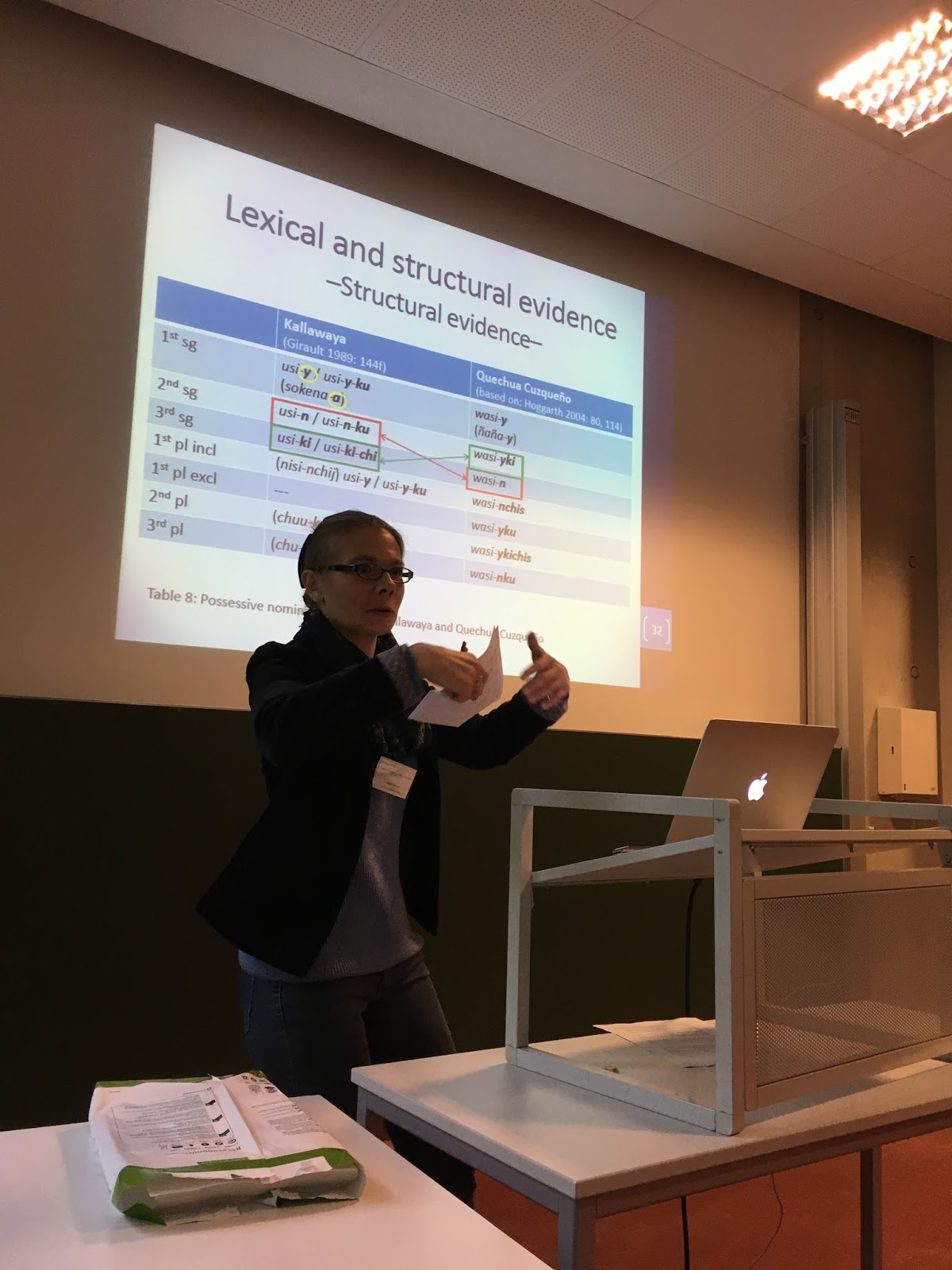
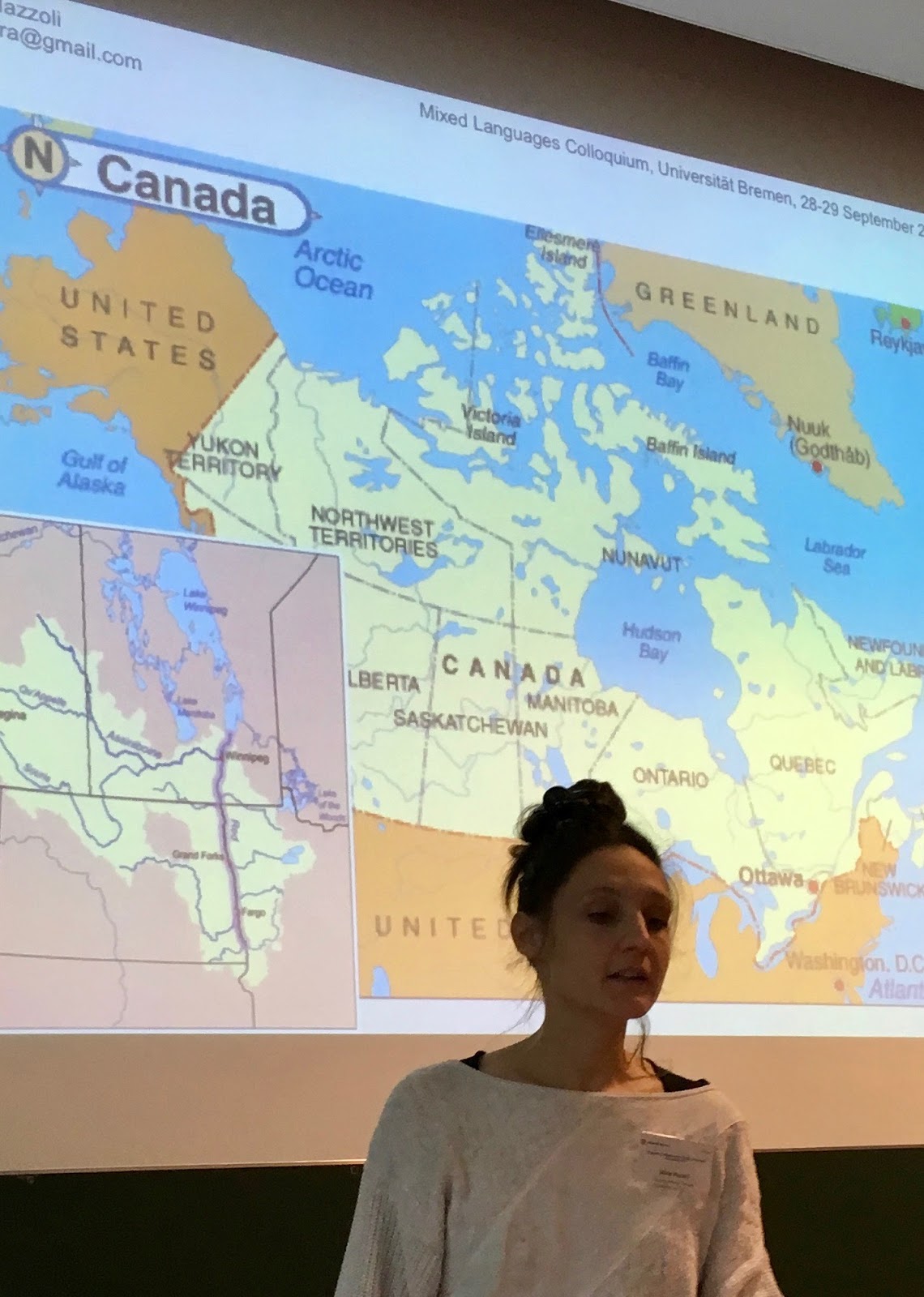
On September 28-29, the University of Bremen hosted a colloquium on Mixed Languages organized by Maria Mazzoli with the support of the Postcolonial Language Studies team.

Mixed languages have fascinated scholars for decades because they present an intriguing type of language contact. They arise in bilingual settings, often as markers of identity or as secret languages, and they combine parts from different language families or branches, showing unique splits that often challenge theories of genetic classification and contact-induced change.

In the colloquium, we heard presentations by international and German scholars on descriptive and theoretical topics, including languages such as Garifuna, Kallawaya, Media Lengua, Michif, and Ma’a/Mbugu, among others.

We would like to thank all the participants for a great colloquium!

 keynote by Katja Hannß / Norval Smith and Frans Hinskens

 Nantke Pecht / keynote by Yaron Matras

 Benjamin Saade / Isabel Deibel

 dinner at Haus am Walde

 keynote by Peter Bakker / Maria Mazzoli

 Anthony Grant / Jesse Stewart

keynote by Maarten Mous / group photo of all the participants

Monday, September 18, 2017

Linguistic Colloquium on Mixed Languages, 28-29 September 2017

Dr. Maria Mazzoli and the Postcolonial Language Studies team invite all interested colleagues, students and visitors to the Linguistic Colloquium on Mixed Languages to take place at the University of Bremen on 28th and 29th September 2017.

Invited speakers:
- Peter Bakker (Arhus University)
- Katja Hannß (University of Cologne)
- Yaron Matras (University of Manchester)
- Maarten Mous (Leiden University)

Location: GW1 HS H1010

The program can be downloaded here in .pdf or viewed by clicking on the images below.


All welcome!

Thursday, February 16, 2017

Maria Mazzoli's participation in a workshop in Stockholm

Maria Mazzoli was invited to participate in the workshop Integration, Inclusion, Assimilation and Ghettoisation in a framework of Mobility at the University of Stockholm, on February 9-10.

She presented on her previous work about the linguistic needs of Portuguese migrants in Andorra, and language ideologies in Andorra.

The workshop was organized by Gabriele Iannàccaro and the Department of Romance and Classical Studies, as part of the European project MIME (Mobility and Inclusion in Multilingual Europe).

Workshop poster and program

Workshop participants

Language landscapes - Andorra

Saturday, July 9, 2016

Institute of Collaborative Language Research - University of Alaska Fairbanks (UAF)

link: http://www.alaska.edu/colang2016

In June 2016 Maria Mazzoli participated in the Institute of Collaborative Language Research (CoLang) at the University of Alaska Fairbanks (UAF), as part of her postdoctoral research project on Michif, the mixed Plains Cree-French language spoken by few Metis communities in Canada and the US. Michif is severely endangered. Today it is spoken by (at most) an estimated 500 Metis speakers. At present, intergenerational transmission of Michif has ceased and no children or people of childbearing age speak the language. All fluent Michif speakers are in their late 60s or older.

In attendance to the CoLang Institute this year were language activists, learners, linguists, speakers, students, teachers, elders, wiki bloggers, archivists, and publishers interested in collaborative research on endangered languages.

CoLang meets every other summer in even-numbered years. The Institute consists of two weeks of workshops followed by a 3 or 4 week long language documentation practicum.

The goals and principles of the Institute are to provide training in documentation, maintenance, revitalization and advocacy for endangered languages, facilitating ethical collaborations between academic and community linguists. CoLang fosters effective practices for in situ language research and resource creation and the maintenance of language diversity, by promoting the creation of lasting resources on under-described languages and assisting community-based language activists in skills development. 

Social media: #colang2016 #languagewarriors #letourgrandparentslanguagelive #rebelsforlanguage

CoLang participants at the University of Alaska Fairbanks, July 1, 2016.    

June 22, 2016, Eliza Jones and Susan Paskvan explain distance delivery of Koyukon language activities in the Yukon-Koyukuk schools.    

Iñupiat danced at Colang’s opening night, June 20, 2016.

Sunday, June 12, 2016

Workshop on Discourse Analysis

The workshop "Fostering Interdisciplinary Communication - Discussing Approaches to Discourse" is going to be held on 30 June 2016 from 9:00-19:30 in GW2 at the University of Bremen. It is organized by Joanna Chojnicka (Postcolonial Language Studies) in cooperation with Worlds of Contradiction.

The workshop brings together doctoral and postdoctoral researchers from the fields of linguistics, history, and cultural and social sciences, who will share their experiences and discuss advantages and disadvantages of applying the method within and across their respective disciplines. Participants will have the unique opportunity to express their concerns, work on possible solutions, learn from each other’s practice, and develop a positive approach to communication across fields in humanities and social sciences, with the overarching goal of establishing new and fostering already existing networks, links and connections. 

The workshop format of the meeting supports intensive collaborative work, while the small size of the group (max. 10 participants) and informal atmosphere guarantee an honest and open discussion. More information on the workshop's website.

Monday, March 21, 2016

The successful BCLL#3 Conference

The Third Bremen Conference on Language and Literature in Colonial and Postcolonial Contexts organized by the Postcolonial Studies teams turned out a success.
Almost 90 registered participants gave and listened to 43 presentations and enjoyed 5 plenary lectures by:
- Hamid Dabashi (Columbia University),
- Gloria Emeagwali (Central Connecticut State University),
- Jeannette Armstrong (University of British Columbia), 
- Lisa Lim (University of Hong Kong) and 
- Michel DeGraff (Massachusetts Institute of Technology).

Some photos from the conference can be seen here.
See the videos of BCLL#3 lectures and presentations here.